Is it possible that the most expensive way to gain more space in 2026 is actually to buy it on the open market? For many homeowners, the traditional route of upgrading via a new postcode has become a lesson in “dead money” spent on stamp duty, legal fees, and estate agent commissions. A detailed loft conversion vs moving house cost analysis reveals that the financial landscape of 2026 demands a more disciplined approach to property appreciation. You’ve likely felt the weight of this decision, weighing the desire for a master suite or a quiet home office against the notorious stress of a UK housing chain.
It’s understandable to feel hesitant about the disruption of a major renovation, yet the alternative often involves sacrificing your equity to taxes rather than your own comfort. This guide provides a definitive financial and lifestyle comparison to help you decide between navigating a volatile market or reinvesting in the home you already love. We’ll examine the exact ROI of a high-quality conversion, the hidden costs of relocating in 2026, and how a precision-managed build can deliver the space you need without the upheaval of moving.
Key Takeaways
- Identify why relocation costs are considered “dead money” and how reinvesting that capital into your current property creates tangible architectural value.
- Navigate the 2026 Stamp Duty landscape with a comprehensive loft conversion vs moving house cost analysis to protect your home equity.
- Evaluate the structural advantages of bespoke dormer designs that maximize head height and functional living space through disciplined engineering.
- Secure a stress-free path to increased square footage while maintaining vital connections to local schools and established community networks.
- Learn how a fixed-price residential construction guarantee provides the financial certainty and professional discipline required for high-end home transformations.
The Financial Reality: Moving vs. Converting in 2026
Choosing to move house in 2026 is often framed as a fresh start, yet a cold look at the balance sheet reveals a different story. Relocation is inherently a series of transactional losses. When you sell a property to buy another of similar calibre, you’re effectively paying a premium for the privilege of staying in the same position. This is the “Sunk Cost” fallacy of the modern property market. Every penny spent on estate agents, taxes, and surveyors is capital that will never return to your pocket. It’s money that vanishes into the machinery of the housing market rather than being woven into the fabric of your home.
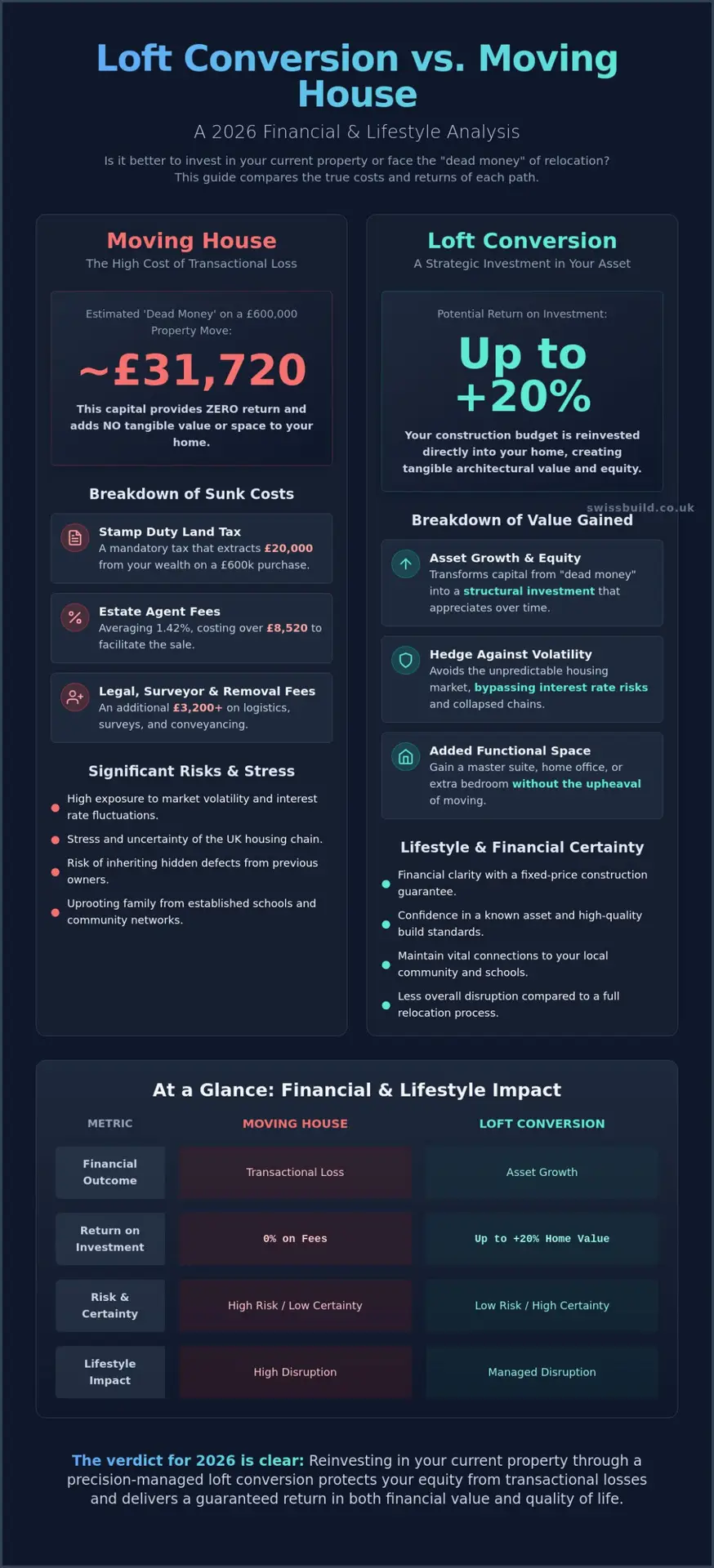
A precise loft conversion vs moving house cost analysis shows that the 2026 Stamp Duty landscape remains the single largest hurdle for homeowners. With rates for a £500,000 purchase reaching £15,000 or more, the financial entry point for moving is steep. This doesn’t even account for the average estate agent fee of 1.42% or the thousands required for legal disbursements. Building your own space typically offers a more favourable cost per square metre than purchasing it through a new mortgage, especially when factoring in the high premium of 2026 property prices. You could easily spend £50,000 on a move without adding a single square metre of usable space to your life.
Asset Growth vs. Transactional Loss
We view construction as a strategic reallocation of capital. By understanding what a loft conversion is in terms of structural investment, it’s clear that your budget transforms from “dead money” into tangible equity. While moving fees provide zero ROI, a bespoke loft can add up to 20% to your home’s total value. Our approach focuses on the invisible quality of the build, ensuring that every structural element contributes to the long-term integrity of your investment. Consider the common transactional losses that vanish when you choose to stay:
- Stamp Duty Land Tax (SDLT) which often exceeds £15,000 for average family homes.
- Estate agent fees, typically averaging 1.42% of your sale price.
- Conveyancing costs and professional legal disbursements.
- The logistical overhead of physical removals and packing services.
The 2026 Market Volatility Factor
Staying put serves as a powerful hedge against the unpredictability of the 2026 housing chain. Reinvesting in your current property allows you to avoid the stress of interest rate fluctuations that can collapse a sale at the eleventh hour. You also benefit from the certainty of a known asset. Moving often means inheriting the hidden defects of a previous owner’s shortcuts; building ensures every beam and joint meets an exacting technical standard. Northamptonshire homeowners are currently pivoting toward high-specification residential extensions as a way to bypass market instability while securing significant capital appreciation.
Moving House: The Hidden Costs That Add Zero Value
The true cost of relocation is often obscured by the excitement of a new floor plan. However, a rigorous loft conversion vs moving house cost analysis reveals that moving is frequently an exercise in financial friction. The most formidable barrier is undoubtedly Stamp Duty Land Tax. For a property valued at £600,000, this tax alone extracts £20,000 from your wealth. This is a sum that buys you exactly zero square metres of extra space. It’s a mandatory contribution to the Treasury that offers no return on investment and provides no architectural improvement to your daily life.
Estate agency fees represent another significant erosion of your hard-earned equity. At an industry average of 1.42%, selling that same £600,000 home costs over £8,500. You’re essentially paying a professional to facilitate the reduction of your net worth. When combined with legal disbursements and surveyor fees, which typically range between £1,200 and £2,200 for a standard sale, the “dead money” begins to accumulate with alarming speed. These mandatory expenses are paid for a property you don’t even own yet, representing a high-stakes gamble on a structure’s invisible condition.
The Breakdown of Moving Friction
The logistics of transition introduce further hidden drains on your capital. Professional removal services for a three-bedroom home often exceed £1,500, particularly when packing services and temporary storage are required. These are purely functional expenses. They facilitate the move but do nothing to enhance the value of your asset. You’re paying for the process of change, not the quality of the result. When you aggregate these costs, the cumulative loss on a £600,000 transaction can easily surpass £32,000 before you’ve even turned the key in the new lock.
The Hidden “New Home” Premium
Rarely is a new property truly finished. Even those marketed as “move-in ready” frequently harbour hidden technical inadequacies or aesthetic misalignments. The “New House Tax” is the inevitable expenditure on window treatments, flooring, and garden adjustments that every new owner faces. Often, these homes require structural updates to meet modern standards. If you find yourself considering a property that needs work, it’s vital to understand the local building regulations in Northamptonshire before committing to a purchase.
By the time you’ve redecorated and fixed the unforeseen issues of a new build, the total transactional loss can be staggering. This is capital that could have been precisely engineered into a bespoke loft conversion in your current residence. Choosing to stay allows you to maintain control over the build quality while ensuring every pound spent increases your own equity. If you value architectural integrity over market movement, exploring our bespoke loft conversions may offer the financial clarity you need.
The Loft Conversion Investment: Precision and Value
Transitioning from the transactional loss of moving to the tangible growth of a renovation requires a shift in perspective. While relocation fees vanish, a high-specification attic transformation consolidates your wealth within your own walls. This is where the loft conversion vs moving house cost analysis leans heavily in favour of the homeowner. Choosing a bespoke design over generic, off-the-shelf kits ensures that every structural modification is engineered to the specific load-bearing requirements of your property. Precision at the planning stage prevents the costly remedial work that often follows “budget” installations, turning a simple attic into a sophisticated architectural asset.
Energy efficiency has become a cornerstone of property value in 2026. A modern conversion involves upgrading the entire home’s insulation profile, often resulting in a measurably improved EPC rating. By meeting the latest 2026 building standards, you aren’t just gaining square footage; you’re reducing long-term operational costs. This systemic improvement to the building’s fabric is a far more disciplined use of capital than paying for a new house that may still require significant energy retrofitting.
Types of Loft Transformations
The choice of structure dictates both the aesthetic impact and the functional gain of the project. Dormer conversions remain the most popular choice for semi-detached homes across the region, as they provide the significant head height and floor area required for master suites. For those wishing to preserve the original roofline, integrating loft conversions in Northampton with high-performance Velux windows creates a flooded-light effect that transforms the atmosphere of the home. These installations aren’t merely decorative; they’re technical components that contribute to a superior thermal envelope.
The ROI of High-End Craftsmanship
According to recent survey data, a growing number of homeowners are prioritising quality improvements over the gamble of the property market. The “cheapest” quote often becomes the most expensive when structural errors or poor finishes require correction. In Northampton, the addition of a master suite or a dedicated home office provides a distinct advantage in resale value, provided the execution is flawless. A bespoke staircase integration preserves the first-floor flow, ensuring the new level feels like a natural extension of the original architecture rather than an afterthought. This commitment to invisible quality is what differentiates a standard build from a true capital investment.
Lifestyle Impact: Disruption vs. Relocation
Decisions regarding your home are rarely purely financial. While a loft conversion vs moving house cost analysis provides the numerical justification for staying put, the social implications of relocation are often more profound. Moving requires a complete recalibration of your daily life, from school runs to commute times. In sought-after Northamptonshire pockets like Moulton or Kingsthorpe, securing a place in a specific school catchment is a hard-won victory that few families are willing to forfeit. Relocating doesn’t just mean a different floor plan; it often means abandoning the established community ties and local amenities that turn a house into a home.
Preserving Your Local Advantage
The value of your current position is often underestimated until it is lost. Staying in your existing property preserves the efficiency of your commute and the reliability of your local transport links. Starting over in a new area carries the “invisible” cost of learning a new neighborhood and rebuilding social networks. Choosing the right builders in Northampton ensures that you can adapt your current home to your evolving needs without sacrificing your hard-earned place in the community.
The Construction Experience
Construction is often feared as a period of chaos, yet professional project management transforms this perception into one of orderly progress. A bespoke conversion typically follows a disciplined 12-week schedule, whereas the UK housing chain in 2026 can easily stretch beyond six months of uncertainty. The systematic management provided by Swiss Build Ltd prioritizes the functionality of your home throughout the build. We employ rigorous site discipline to shield your family from the typical stresses of a renovation, ensuring that the structural phases are managed with minimal intrusion. This methodical approach allows your household to remain operational while the invisible quality of the build is established above.
There is a distinct psychological satisfaction in watching your architectural vision materialize within your own walls. This process feels like a natural evolution of your lifestyle rather than a forced upheaval. For those seeking to maintain mental clarity during such significant life transitions, commonsensepsychologyforeverydayliving.com offers story-driven insights into practical psychology for everyday living. Unlike the gamble of moving, where you inherit the design choices of others, building allows you to tailor every millimetre to your family’s unique requirements. To see how we manage high-end projects with absolute precision, view our bespoke loft conversions service.
The Swiss Build Ltd Difference: Precision Fixed-Price Delivery
A successful renovation relies on more than just craftsmanship; it requires the rigorous discipline of professional project management. While the loft conversion vs moving house cost analysis clearly favors reinvestment, the execution of that build determines your ultimate peace of mind. Many firms suggest a 10-15% contingency fund to cover “unforeseen” surprises. We find this approach insufficient for a discerning client. Our fixed-price residential construction guarantee eliminates financial ambiguity, ensuring that the quote you receive is the price you pay. With 26 years of industry expertise, Swiss Build Ltd anticipates structural complexities long before the first beam is placed.
Our end-to-end project management covers every detail from the initial conceptual design to the final fit-out. This all-inclusive service is designed to alleviate the typical anxieties associated with high-end construction. We believe a beautiful space is only successful if it’s built to an exacting technical standard. This focus on the invisible quality of the build ensures your new master suite or home office functions as perfectly as it looks. Nothing is left to chance. The marriage of functionality and design is not a luxury; it’s a prerequisite for a successful capital investment.
Eliminating Budget Creep
Financial transparency is the foundation of our client relationships. We provide comprehensive quotes that detail every aspect of the project, removing the risk of hidden extras or sudden price hikes. Our stage-aligned payment structure ensures you’re paying for specific milestones achieved, mirroring the logical progression of the build itself. This methodical approach has made Swiss Build Ltd the steady hand for complex Northamptonshire renovations, providing a level of corporate maturity that protects your investment from the volatility often found in the residential sector.
Next Steps to Your Bespoke Space
The journey toward your new square footage begins with a technical feasibility survey. This allows us to assess the structural integrity of your attic and visualize how a master suite or home office will integrate into your existing floor plan. You’ve already seen how staying put protects your equity and preserves your community ties. Now, it’s time to secure the precision-managed build that makes that decision a reality. Request a fixed-price quote for your Northampton loft conversion and take the first step toward a bespoke architectural transformation.
Securing Your Property’s Future Value
Choosing between relocation and renovation is a significant decision that shapes both your financial portfolio and your family’s daily rhythm. As our loft conversion vs moving house cost analysis has demonstrated, the 2026 property market often penalizes movement through heavy transactional losses and “dead money” taxes. By contrast, a bespoke attic transformation converts that potential loss into permanent equity. You preserve your place in the community while gaining a sanctuary tailored to your exact technical and aesthetic requirements. This approach prioritizes long-term asset growth over short-term market friction.
At Swiss Build Ltd, we bring over 26 years of architectural and construction expertise to every project. We specialize in high-end, bespoke transformations that marry superior craftsmanship with rigorous project discipline. Our signature fixed-price guarantee ensures total budget certainty, allowing you to invest with absolute confidence in the final outcome. Secure your fixed-price quote with Swiss Build Ltd to begin the transition from a conceptual vision to a precision-engineered reality. Your home’s next chapter deserves the steady hand of an expert artisan dedicated to technical mastery and luxury living.
Frequently Asked Questions
Is it cheaper to do a loft conversion or move house in 2026?
A loft conversion is significantly more cost-effective because it bypasses the non-recoverable transactional fees that define the 2026 property market. While moving requires an immediate outlay for taxes and commissions, a conversion concentrates your budget into structural equity. A comprehensive loft conversion vs moving house cost analysis shows that staying put allows you to avoid the “moving tax” and instead finance a high-specification architectural improvement that remains part of your net worth.
How much value does a bespoke loft conversion add to a Northampton home?
In desirable areas such as Moulton and Kingsthorpe, a bespoke conversion can increase a property’s market value by up to 20% by addressing the high demand for five-bedroom family homes. This value is maximized when the build quality mirrors the existing home’s architectural integrity. Beyond the immediate square footage gain, a master suite with an en-suite or a high-performance home office serves as a primary selling point that distinguishes your home in the local market.
What are the hidden costs of moving house that I should consider?
Beyond Stamp Duty and estate agent fees, homeowners must account for mortgage arrangement fees, overlapping council tax payments, and mandatory property surveys for the new residence. These expenses, along with the “New House Tax” of redecorating and installing window treatments, often total tens of thousands of pounds. These costs provide no return on investment, representing capital that is permanently removed from your housing budget without adding any functional space.
Do I need planning permission for a loft conversion in Northamptonshire?
Most residential conversions fall under Permitted Development rights, provided they do not exceed 40 cubic metres for terraced houses or 50 cubic metres for semi-detached and detached homes. However, if your property is a listed building or located in one of Northampton’s many conservation areas, a full planning application is required. We recommend verifying these limits with West Northamptonshire Council to ensure your project adheres to the latest 2026 regional planning guidelines.
How long does a typical loft conversion take compared to a house move?
A precision-managed conversion typically takes 12 weeks from the first structural modification to the final fit-out, providing a predictable timeline for your family. In contrast, navigating a housing chain in 2026 often takes six months or longer, with a high risk of the transaction collapsing due to external market factors. Choosing to build offers a disciplined, fixed schedule that allows you to plan your lifestyle changes with far greater certainty than the open market allows.
Can any loft be converted, or are some roofs unsuitable?
The majority of lofts are suitable for conversion provided there is a minimum head height of 2.2 metres across at least half of the intended floor area. While older rafters are generally simpler to adapt, modern fink-truss roofs can also be converted using specialized steel beams to redistribute the load. A technical feasibility survey is essential to identify the structural requirements of your specific roof and to ensure the new floor meets all current building safety standards.
How does Swiss Build Ltd manage the disruption of a loft conversion?
Swiss Build Ltd employs a systematic project management strategy that prioritizes site discipline and minimal intrusion into your daily routine. We manage the build through external scaffolding where possible, ensuring that the heavy structural work is separated from your living areas. By maintaining a methodical progression and clear communication, we shield your family from the typical anxieties of renovation, delivering a stunning result through a process defined by professional authority and calm expertise.
What is the “dead money” associated with moving house?
“Dead money” refers to the non-recoverable capital spent on the friction of relocation, such as Stamp Duty, legal disbursements, and estate agent commissions. These are purely transactional costs that do not enhance the quality or value of the asset you are moving into. Identifying these losses is a vital part of a loft conversion vs moving house cost analysis, as it highlights the financial advantage of reinvesting those same funds into a bespoke architectural transformation of your current home.