
Financial transparency is not merely a courtesy in high-end construction; it is the structural integrity of the relationship between a homeowner and their artisan. A meticulously defined loft conversion payment schedule serves as the primary blueprint for this trust, ensuring that every pound invested mirrors the tangible progress made within your rafters. You likely feel that the most daunting part of an attic transformation isn’t the architectural complexity, but the vulnerability of releasing significant capital before the first structural beam arrives. It’s an understandable anxiety, particularly when industry milestones like “structural completion” or “first fix” feel intentionally opaque.
This guide will empower you to master the financial structure of your project through a professional milestone framework designed to provide total security and uncompromising quality. We will explore how a disciplined sequence of payments protects your investment, clarifies complex terminology, and confirms the financial stability of your chosen partner. By the end, you’ll have a clear roadmap that replaces uncertainty with the calm confidence of a perfectly managed build.
Key Takeaways
- Learn how a structured loft conversion payment schedule acts as a contractual roadmap, ensuring you only release funds for tangible, completed work.
- Identify financial red flags, such as deposits exceeding 25 percent, and understand how to protect your capital through professional milestone framing.
- Discover the critical link between your financial outgoings and objective Building Control inspections to verify structural integrity before payment.
- Master the use of retention fees to safeguard your investment, ensuring your builder remains committed to perfection long after the primary construction ends.
- Gain peace of mind by understanding how fixed-price frameworks and milestone accountability eliminate the risk of hidden costs during your renovation.
The Fundamentals of a Professional Loft Conversion Payment Schedule
A professional loft conversion in the United Kingdom is a complex architectural undertaking that requires more than just skilled carpentry; it demands financial rigour. Think of your loft conversion payment schedule as a contractual roadmap that guides the project from its conceptual infancy to technical completion. It isn’t merely a list of dates. It’s a mechanism for project success that ensures every pound invested mirrors the tangible progress made within your rafters. By adhering to a milestone framework, you transform a potentially stressful transaction into a disciplined exchange of value.
One of the hallmarks of a master builder is the commitment to paying in arrears. This means that, after an initial commencement fee, subsequent payments are only triggered once specific, tangible stages of work are finished. For homeowners in Northampton, this structure provides an essential layer of security. It ensures your capital remains protected and that the builder is incentivised to maintain momentum and quality. Professional firms like Swiss Build Ltd avoid large, unsubstantiated upfront deposits because their financial stability allows them to fund the initial procurement of materials and specialist labour without over-exposing the client.
The Role of Cash Flow in High-End Construction
High-end construction relies on a steady, predictable flow of resources. Builders require staged payments to manage the procurement of bespoke materials and to secure the time of elite specialists, such as gas engineers or plumbing experts. A fair schedule balances this need for liquidity with your need for security. It’s helpful to distinguish between a booking deposit, which secures your slot in the builder’s calendar, and a commencement fee, which covers the immediate costs of site setup and initial material deliveries. This clarity prevents confusion and keeps the project moving without financial friction.
Aligning Expectations: Homeowner vs. Specialist Builder
Transparency in financial milestones is a direct reflection of a builder’s corporate maturity. It bridges the gap between your need for security and the builder’s operational requirements. When milestones are clearly defined in a written contract, you avoid the dangerous pitfalls of handshake agreements or vague payment dates. A disciplined builder like Swiss Build Ltd won’t shy away from a detailed schedule; they welcome it as a tool for accountability. This systematic approach ensures both parties are aligned, fostering a relationship built on technical mastery and mutual trust rather than guesswork or anxiety.
Standard Milestones: A Phased Approach to Attic Transformation
A successful attic transformation is a symphony of structural engineering and interior refinement. To maintain the rhythm of the build, a standard loft conversion payment schedule is divided into logical, verifiable phases. This structure ensures that your financial commitment always tracks with the physical reality of the construction site. It moves from the initial conceptual stages through to the complex structural work and finally to the exquisite finishes that define a luxury space.
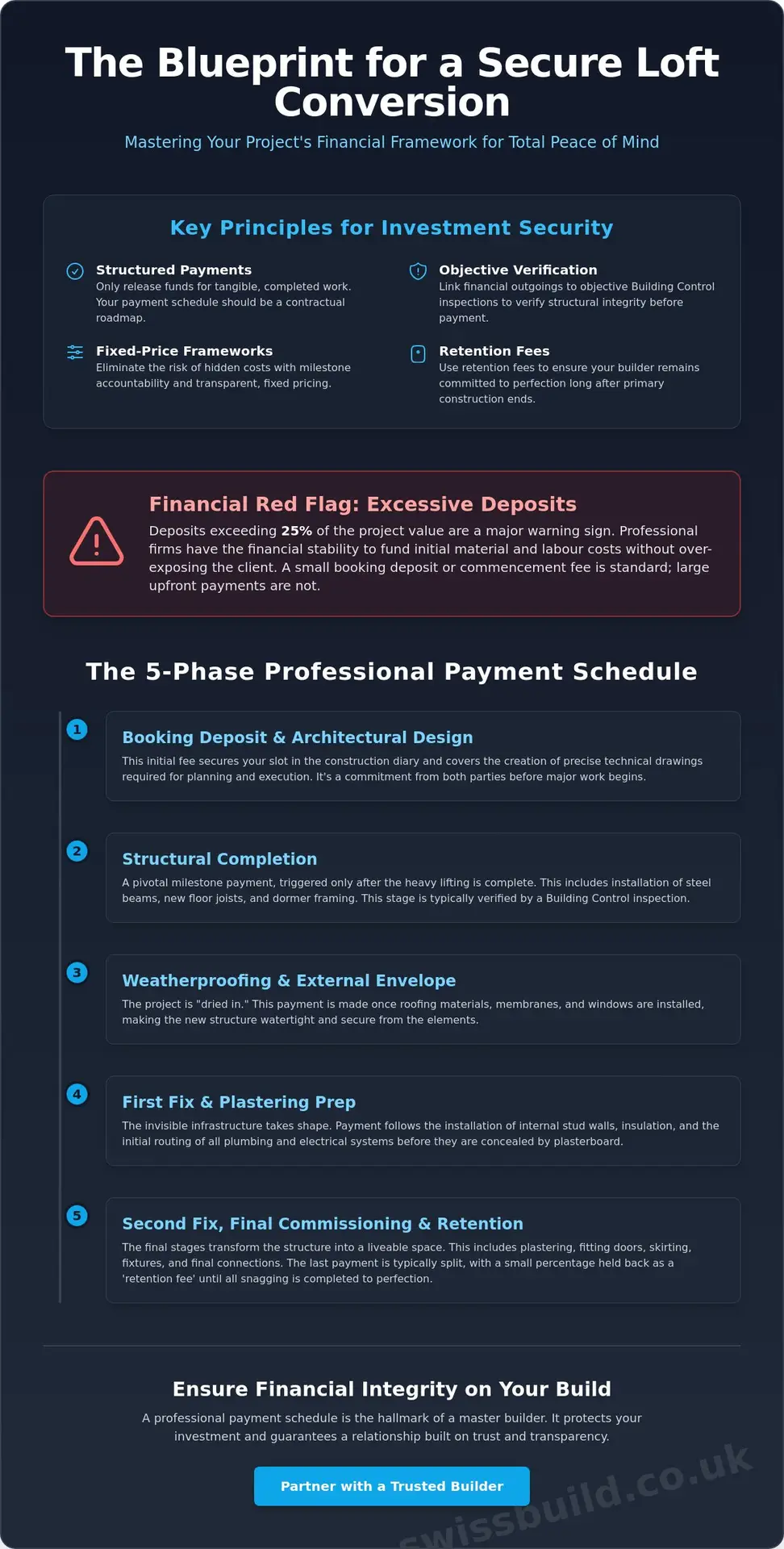
- Phase 1: The Booking Deposit and Architectural Design. This initial stage secures your place in the construction diary and covers the technical drawings required for a precise execution.
- Phase 2: Structural Completion. This is the pivotal moment when the heavy lifting occurs, including the installation of steel beams, floor joists, and dormer framing.
- Phase 3: Weatherproofing and External Envelope. At this stage, the project is “dried in” with the installation of roofing materials and windows.
- Phase 4: First Fix. The invisible infrastructure takes shape, including internal partitions and the intricate routing of plumbing and electrical systems.
- Phase 5: Second Fix, Plastering, and Final Commissioning. The transition to a liveable space is completed with surface finishes, fixture installations, and final safety checks.
Structural Milestones: The Heavy Lifting
In the context of a professional loft conversion payment schedule, “Structural Completion” is a term of absolute precision. It signifies the point where the new floor and roof supports are fully integrated into the existing building fabric, making the space safe and load-bearing. This stage typically represents the largest single payment because it encompasses the procurement of high-grade structural steels and the intensive labour required for their installation. You should always verify that the steels are in place and correctly seated before releasing funds for this milestone. This verification provides the peace of mind that the most critical part of the engineering is sound.
The Internal Fit-Out: From Shell to Living Space
Once the shell is secure, the focus shifts to the internal fit-out. It’s essential to distinguish between “first fix,” where services are hidden behind walls, and “second fix,” which involves visible finishes like sockets and taps. For instance, all plumbing and heating systems must undergo rigorous pressure testing before plastering begins to prevent future complications. For those seeking the highest standards in interior execution, our Property Refurbishment Northampton guide outlines the exacting benchmarks required for a truly premium finish. If you’re ready to discuss the technical specifics of your own project, exploring our bespoke loft conversion services is a logical next step.
Deposits and Retentions: Safeguarding Your Investment
A sophisticated loft conversion payment schedule is built on the principle of balanced risk. While a builder requires the fiscal commitment to mobilise resources, a homeowner deserves the assurance that their capital is protected through every phase of the transformation. This equilibrium is maintained through two primary mechanisms: the controlled deposit and the strategic retention fee. Together, they form a safety net that ensures project momentum never comes at the expense of your financial security or the project’s ultimate quality.
Calculating a Fair Deposit
In high-end residential construction, a deposit exceeding 25 percent of the total project value is a significant red flag. It often indicates that a contractor lacks the necessary liquidity to manage the initial stages of a build without immediate client funding. A fair deposit serves specific, justifiable purposes: securing insurance, procuring bespoke materials like timber and Velux windows, and reserving your slot in a busy construction calendar. Swiss Build Ltd prioritises financial stability, avoiding the need for high upfront costs. This disciplined approach ensures that your initial investment is always backed by clear, contractual obligations and immediate site activity.
The Power of the Retention Clause
The retention fee is an essential component of a professional build that many lower-tier contractors often omit. By holding back a percentage of the final bill, typically between 2.5 percent and 5 percent, you ensure the builder remains committed to your home long after the heavy machinery has departed. This fund is designed to incentivise the completion of minor snagging issues that only become apparent once the space is occupied. It provides a practical solution for addressing the natural settlement of a new structure.
- The Defects Liability Period: This is a formal window, usually lasting three to six months, during which Swiss Build Ltd remains responsible for rectifying minor issues like plaster hairline cracks or hardware adjustments.
- Incentivised Excellence: Retentions ensure that the final five percent of the project receives the same meticulous attention to detail as the structural phases.
- Fiscal Peace of Mind: Knowing that a portion of the payment is tied to the long-term performance of the build alleviates the common fear of a builder disappearing before the final touches are perfected.
The final release of these funds occurs only after a post-completion inspection confirms that every detail meets the exacting standards promised at the outset. This systematic approach to the final stages of your loft conversion payment schedule reflects a corporate maturity that values substance and long-term reliability over quick completions.
Contractual Precision: Linking Payments to Building Regulations
The most effective way to ensure your loft conversion payment schedule remains fair is to anchor it to objective, third-party verification. While a builder may claim a stage is complete, the local Building Control inspector provides the definitive word on technical compliance. By aligning your financial outgoings with these mandatory inspections, you create a system where quality is a prerequisite for payment. This method transforms the inspection process from a regulatory hurdle into a powerful tool for homeowner protection, ensuring that your capital is only released for work that meets national safety standards.
Linking the structural payment to the inspector’s approval of the steels is a hallmark of a disciplined project. It ensures that the primary load-bearing elements of your new space are correctly installed and compliant with structural engineering calculations before you release significant capital. The final payment trigger should always be the receipt of the Building Regulations Completion Certificate. This document is the ultimate proof that the work is safe, legal, and insurable, protecting the long-term value of your home. Without this certificate, the space cannot be legally classed as a habitable room, making it a critical final milestone in any professional financial framework.
The Inspection Cycle in Northamptonshire
In our region, the inspection cycle follows a predictable and rigorous path. For a typical project, the inspector will visit at key intervals: when the structural steels are in place, once the insulation is installed but before it is covered, and finally when the build is finished. Using the inspector’s site visit notes as evidence for stage completion removes the ambiguity from your loft conversion payment schedule. For a deeper understanding of these requirements, our guide on Building Regulations Northamptonshire provides a comprehensive breakdown of the standards your project must meet to be considered a successful transformation.
Documenting Every Transaction
A professional build is defined by its paper trail. Every stage payment should be accompanied by a formal VAT invoice, clearly stating the milestone achieved and the work completed. Maintaining a meticulous project file that includes these receipts alongside your Building Control certificates is essential for future property valuations or insurance claims. Swiss Build Ltd utilises formal project management software to provide this level of transparency, ensuring that every financial transaction is logged with architectural precision. This systematic approach reflects a commitment to total accountability and technical mastery. If you value this level of transparency and want to ensure your home meets the highest standards, we invite you to explore our bespoke loft conversion services today.
The Swiss Build Commitment: Fixed Pricing and Milestone Accountability
The true value of a loft conversion payment schedule is only realised when it is underpinned by a fixed-price commitment. Without this, the schedule remains a moving target, prone to the payment creep that often plagues less disciplined construction projects. We eliminate this financial uncertainty by providing a framework where every milestone corresponds to a predetermined, non-negotiable fee. Our 26 years of experience in the high-end residential sector allow us to forecast costs with architectural precision, ensuring that the price agreed at the start is the price you pay at the end.
For our clients in Moulton and Kingsthorpe, we offer a signature No Hidden Costs guarantee. This isn’t a marketing claim; it’s a reflection of our methodical approach to project management. We account for every variable, from structural steel requirements to the final plumbing and heating commissions, before the first tool is lifted. This level of foresight ensures that your capital is never subject to unexpected demands, allowing you to manage your finances with the same calm expertise we bring to the build site. It’s a partnership rooted in total accountability and technical mastery.
Precision Project Management in Northampton
Our approach to Bespoke Loft Conversions is defined by a dedication to punctuality and technical excellence. We manage an elite network of specialist trades, including certified gas works and heating experts, ensuring that every phase of the construction is executed to an exacting standard. By maintaining a steady, rhythmic communication style, we ensure you’re always informed of project progress. This discipline ensures that milestones are met on time, allowing the loft conversion payment schedule to flow logically and without delay. It’s a systematic process where nothing is left to chance.
Starting Your Journey with Swiss Build
Your journey toward a transformed home begins with a comprehensive consultation where we establish the financial framework for your project from day one. We provide detailed quotes that reflect the true cost of architectural integrity, covering everything from high-performance Velux windows to intricate electrical routing. We encourage you to consult our Choosing the Best Builders in Northampton guide to see how our standards of transparency compare to the wider industry. By setting a clear, milestone-based roadmap, we provide the peace of mind that comes from superior craftsmanship and systematic management.
Executing Your Vision with Disciplined Transparency
A successful attic transformation is the result of a deliberate marriage between architectural vision and fiscal discipline. By implementing a structured loft conversion payment schedule, you replace the typical anxieties of renovation with a transparent framework that rewards tangible progress. You now understand how linking payments to Building Control inspections and maintaining a strategic retention fee ensures your investment remains protected from the first steel beam to the final commissioning.
We bring over 26 years of industry expertise to every project, offering full project management for a completely stress-free experience. Our fixed-price guarantee ensures total financial peace of mind, eliminating the risk of hidden costs or budget creep. If you’re ready to elevate your home through a process defined by technical mastery and absolute reliability, we’re here to provide the steady hand your vision requires.
Secure your bespoke loft conversion with a precision-managed quote from Swiss Build
Frequently Asked Questions
How much of a deposit is normal for a loft conversion?
A deposit of 10 to 25 percent is considered the industry standard for a professional project. This initial sum secures your place in the construction schedule and covers the preliminary costs of site mobilisation and insurance. You should be cautious of any contractor requesting more than 25 percent upfront; this often suggests a lack of financial stability or operational discipline. A fair deposit ensures both parties are committed without over-exposing your capital.
Should I pay for materials before they arrive at my house?
Payments for materials should generally occur after they’ve been delivered to your site or installed as part of a completed milestone. While bespoke items like high-specification Velux windows may require an earlier commencement fee to secure procurement, most general materials are funded by the builder’s own liquidity. This approach ensures your money is always backed by tangible assets on your property, maintaining the integrity of your loft conversion payment schedule.
What happens if a milestone is delayed?
If a project milestone is delayed, the corresponding payment remains in your account until the work meets the required technical standard. A professional schedule is built on physical progress rather than arbitrary calendar dates. This structure protects you from paying for work that hasn’t happened. It also encourages the builder to resolve any logistical or technical issues promptly to maintain the project’s financial momentum and their own cash flow.
Is it normal to pay a retention fee for a loft conversion?
Yes, a retention fee of 2.5 to 5 percent is a standard practice in high-end construction to ensure long-term quality. This final portion of the contract value is held back for three to six months after the main works are finished. It acts as a performance bond, ensuring the builder returns to address minor settlement issues or snagging. This mechanism provides essential peace of mind and reflects a builder’s commitment to lasting craftsmanship.
Can I pay my builder in cash to save on VAT?
Professional builders don’t accept cash payments to bypass VAT, as this undermines the legal and financial security of your project. A legitimate build requires a clear paper trail of VAT invoices to validate warranties, insurance, and future property sales. Choosing a VAT-compliant partner ensures that your investment is fully documented and that you’re protected by consumer rights and professional indemnity insurance, which cash agreements simply cannot provide.
What is the difference between a payment schedule and a quote?
A quote provides the total financial commitment for your project, while a loft conversion payment schedule defines the timing and conditions of those payments. The quote outlines the scope of work and materials, such as bespoke joinery or plumbing and heating systems. The schedule then breaks that total figure into logical, manageable phases. This distinction ensures you have a clear understanding of both the final cost and the cash flow requirements.
How do I know when a stage is officially “complete”?
A stage is officially complete when it meets the technical specifications outlined in your contract and passes any required Building Control inspections. You shouldn’t rely on visual assessments alone. For structural milestones, the inspector’s approval of steels or floor joists serves as the ultimate objective verification. This alignment between physical work and regulatory sign-off ensures that every payment you make is justified by a safe, compliant, and high-quality addition to your home.
What documents should I receive after making the final payment?
Upon final payment, you should receive a comprehensive project file containing your Building Regulations Completion Certificate and all relevant safety documents. This includes Gas Safe and NICEIC electrical certificates for any plumbing and heating or wiring works. You should also receive written warranties for materials like roofing or windows. These documents are vital for your home insurance and will be required by solicitors if you ever decide to sell your property.