

The most significant risk to a bespoke renovation isn’t found in the architectural drawings, but in a fractured financial structure. In a 2026 market where transaction costs for moving can exceed £40,000, investing in your current residence is a sophisticated choice, yet it requires a disciplined home extension payment plan to succeed. You likely feel that a large upfront deposit is an unnecessary leap of faith, and you’re right to seek a more transparent alternative.
We understand that true peace of mind comes from seeing your investment take physical shape before the next stage of funding is released. This guide explains how to structure your finances through rigorous, milestone-based schedules that eliminate the anxiety of hidden costs. You’ll discover how to navigate the current lending environment, from further advances to second charge mortgages, ensuring your payment rhythm mirrors the precision of the build itself. We’ll show you how to transform a complex financial process into a steady, methodical journey toward a finished home that meets your exact technical standards.
Key Takeaways
- Understand the architecture of a milestone-based schedule where funds are only released upon the verified completion of specific build stages.
- Protect your investment by ensuring your home extension payment plan limits initial deposits and aligns subsequent costs with tangible physical progress.
- Evaluate 2026 funding strategies, such as further advances or second charge mortgages, to maintain liquidity while leveraging property equity.
- Identify critical financial red flags and documentation requirements to ensure your project maintains the transparency expected in high-end construction.
- Learn how a fixed-price fee model provides the financial discipline and certainty required to execute complex, bespoke renovations without scope creep.
Understanding the Architecture of a Home Extension Payment Plan
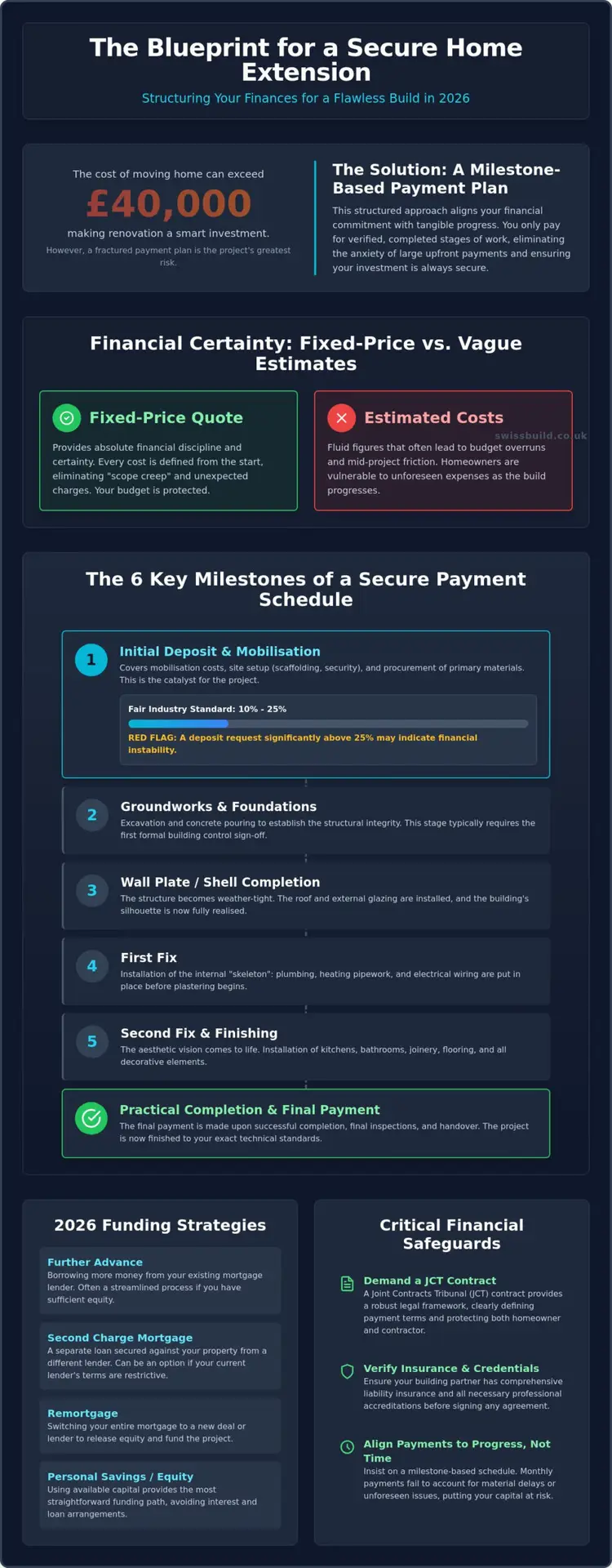
A home extension payment plan isn’t merely a series of invoices; it’s a strategic framework that aligns your financial commitment with the tangible evolution of your home. By definition, this plan is a contractual schedule of staggered payments linked to specific build stages. It ensures that capital flow follows physical progress, providing a layer of security that a lump-sum payment simply cannot offer. In Northamptonshire’s high-end market, where architectural complexity is the norm, this structured approach is vital for maintaining project momentum.
It’s crucial to distinguish between project financing and your payment schedule. Financing refers to how you secure the funds, whether through personal savings, a remortgage, or a home equity loan. Conversely, the payment schedule dictates the rhythm at which those funds are distributed to your building partner. Swiss Build Ltd leverages 26 years of industry experience to ensure these two elements work in harmony, preventing the common anxiety of being “out of pocket” before work has actually commenced.
The initial deposit serves as the catalyst for your project, covering mobilisation costs and the procurement of bespoke materials. In 2026, a fair industry standard for this commitment typically ranges between 10% and 25% of the total contract value. Any request for a significantly higher upfront sum should be viewed with caution, as it often indicates a lack of financial stability or a less disciplined approach to project management.
Fixed-Price Quotes vs. Estimated Costs
Estimates are often the precursor to budget creep and mid-project friction. They’re fluid figures that can fluctuate as the build progresses, leaving homeowners vulnerable to “scope creep” and unexpected costs. We believe precision is the antidote to this uncertainty. A fixed-price residential construction fee model provides the absolute foundation for a reliable home extension payment plan. By defining every cost with technical mastery from the outset, Swiss Build Ltd eliminates the potential for financial disputes and ensures that your investment is managed with rigorous discipline. For those seeking further examples of specialists who apply this level of precision to residential construction, you can visit Built By LCY Pty Ltd to explore their approach to complex extensions and second-storey additions.
The Legal Framework of Your Payment Schedule
Professional building firms typically use JCT (Joint Contracts Tribunal) standard forms of contract to govern the relationship. These documents provide a robust legal framework that protects both the homeowner and the contractor by clearly defining payment terms and dispute resolution processes. A payment plan is a tool for financial transparency and project momentum. This formal structure ensures that every pound spent is accounted for, reflecting a cultural dedication to punctuality and total accountability that defines a premium building experience.
The Milestone-Based Payment Schedule: A Step-by-Step Breakdown
A professional home extension payment plan operates on the principle of earned value. Rather than arbitrary monthly installments, payments are triggered by the successful completion of specific physical stages. This methodical approach ensures that your capital is always backed by tangible assets on your property. For those currently Comparing Funding Strategies, understanding this schedule is paramount to maintaining a healthy cash flow throughout the build.
The journey begins with Mobilisation and Site Setup. This initial stage covers the logistical foundation, including scaffolding, site security, and the procurement of primary materials. Following this, the Groundworks and Foundations phase requires significant precision. Excavation and concrete pouring establish the structural integrity of the project, often requiring the first formal building control sign-off. The third milestone is Wall Plate or Shell Completion. At this point, the structure becomes weather-tight, with the roof and external glazing usually in place. The building’s silhouette is now fully realised.
Internal progress then shifts to the First Fix. This involves the skeletal installation of plumbing, heating, and electrical systems before plastering begins. Finally, the Second Fix and Finishing stage brings the aesthetic vision to life. This includes the installation of bespoke kitchen renovations, joinery, and decorative elements. Each stage represents a clear advancement in value, ensuring the financial rhythm matches the architectural execution.
Why Milestones Beat Monthly Payments
Monthly payment schedules often fail to account for the realities of construction. If a project stalls due to weather or material delays, a monthly plan continues to demand funds regardless of progress. Milestone payments eliminate this risk. You only release capital once a stage is verified as complete. Verification usually involves a site walkthrough with your project manager and, where necessary, an independent certificate from building control. This system provides a level of transparency that protects your investment from the start.
Retention Fees: The Final Security Layer
The final component of a disciplined financial plan is the retention fee. This is a small percentage of the total contract, typically between 2.5% and 5%, held back after the main works are finished. It serves as a guarantee that any minor “snagging” issues or latent defects will be addressed promptly. Releasing this final sum only after a final inspection ensures long-term accountability. It’s the hallmark of a firm that values technical perfection over a quick exit, providing the ultimate peace of mind for the homeowner.
Financing Your Extension: Comparing Funding Strategies for 2026
Securing the right funding is a prerequisite for any disciplined construction project. In 2026, the financial landscape is defined by steady interest rates, with the Bank of England base rate holding at 3.75%. Homeowners often face the choice between liquidating personal assets or leveraging debt to fund their vision. Using personal savings remains the most cost-effective route, as it avoids interest charges entirely, yet it requires careful liquidity management to ensure a contingency fund remains intact. It’s essential that your chosen funding source aligns perfectly with your home extension payment plan, ensuring capital is liquid exactly when milestones are reached.
For larger projects, remortgaging or securing a further advance is a common strategy. With average 5-year fixed mortgage rates at approximately 5.54%, many homeowners prefer further advances from existing lenders to preserve favorable rates secured in previous years. These home renovation financing options allow for substantial capital raises without the friction of a full market switch. Unsecured personal loans offer a faster alternative for smaller refurbishments, though they typically carry higher interest rates and shorter repayment terms. Specialist developer finance is another avenue for high-value bespoke builds, providing tailored structures for complex residential works.
Leveraging Equity in Northamptonshire Properties
In areas like Moulton or Kingsthorpe, a bespoke extension is a calculated investment. A well-executed project can add between 5% and 15% to a property’s value, and even more for loft conversions. Lenders in 2026 are increasingly sophisticated, often considering the “future value” of a home once the build is complete. Engaging a local surveyor can provide the documentation needed to justify this valuation to a bank, turning a conceptual design into a bankable asset. This foresight allows you to borrow against the equity you’re creating, rather than just the equity you currently hold.
This focus on property appreciation is a cornerstone of the luxury real estate market worldwide. For those looking to see how these principles are applied to premium listings in Switzerland, you can explore Vente de villas et appartements to see how JSRE Sàrl handles the valuation and sale of high-end homes.
Tax and Legal Considerations
Financial clarity also depends on understanding statutory costs and tax incentives. While the standard VAT rate is 20%, certain energy-efficient installations benefit from a 0% rate until at least 2027. This includes heat pumps and specific insulation materials. Your budget must also account for the technical requirements of building regulations in Northamptonshire. These standards ensure the invisible quality of the build, from foundation depth to thermal efficiency. Maintaining a meticulous paper trail for all transactions is the final step in professional project management, ensuring total accountability for every pound invested in your home.
Avoiding Financial Pitfalls: Red Flags to Watch For
Construction involves significant capital, making financial vigilance mandatory. While a bespoke project is an aspirational journey, it must be grounded in rigorous discipline to avoid the common traps of the industry. One of the most immediate red flags is the offer of “Cash Only” discounts. These lack a formal paper trail and compromise your legal standing, leaving you without recourse should the build fail to meet technical standards. Total accountability requires every transaction to be documented within your home extension payment plan.
As established earlier, an initial deposit should never exceed 10% to 25% of the total contract value. Demands for higher upfront sums often suggest a builder is using your capital to finish a previous project, a practice that introduces systemic risk to your build. Similarly, you must ensure your building partner maintains comprehensive insurance. Public liability and all-risks cover are non-negotiable requirements that protect your property and the individuals on-site. Without these, you are personally exposed to significant financial liabilities.
Managing “Variation Orders” is another critical area for financial control. Changes to the original design are common in high-end renovations, yet they must be managed with precision. Any deviation from the initial fixed-price quote should be documented in writing, detailing the cost and time implications before the work commences. This prevents the “scope creep” that often leads to budget exhaustion in the final stages of a build.
The “Front-Loaded” Payment Trap
A front-loaded schedule asks for a disproportionate amount of money before substantial work is completed. This creates a dangerous imbalance where the builder has little incentive to maintain momentum. You should always ensure the value of the work physically present on your site exceeds the total amount paid at any given time. A professional payment plan is a shield against project abandonment and financial exposure. If the financial rhythm feels skewed toward the contractor’s benefit rather than project progress, it is a sign of poor professional discipline.
Transparency in Material Procurement
Bespoke projects frequently involve long-lead items such as custom glazing or Velux windows. When a home extension payment plan requires advance payment for these materials, ensure they are “vested” in your name. This legal distinction means that once you have paid for the items, they belong to you, even if they are still stored at a supplier’s warehouse. Using a selection checklist for builders in Northampton can help you identify firms that uphold these standards of transparency. To ensure your project is managed with this level of precision, you can contact our expert team today to discuss your specific requirements.
The Swiss Build Approach: Precision Management and Financial Clarity
Swiss Build Ltd represents a cultural dedication to technical mastery and professional authority. With 26 years of industry experience in Northampton, we have refined a process where superior craftsmanship meets systematic management. Our fixed-price residential construction fee model isn’t just a promise; it’s a disciplined commitment to financial clarity. This approach ensures that your home extension payment plan is built on a foundation of absolute reliability, removing the typical anxieties associated with high-end renovation and replacing them with a sense of calm expertise.
The “Swiss Build Ltd Milestone System” is the architecture of this transparency. While many firms rely on estimated costs that fluctuate, we provide a definitive financial roadmap before a single brick is laid. By acting as your single point of contact through full project management, Swiss Build Ltd eliminates the friction often found between architects, lenders, and contractors. This integrated method ensures that every phase, from the initial groundworks to the final finish, is executed without error. The invisible quality of the build serves as our primary brand signature, ensuring that your home’s functionality is as perfect as its design.
Bespoke Solutions for Discerning Homeowners
Every project is a unique architectural journey that requires a tailored approach. Whether you are seeking bespoke loft conversions or complex ground-floor extensions, Swiss Build Ltd tailors the payment structure to match the specific scale and complexity of your vision. Our transparent reporting provides an exacting view of where your investment is going. You’ll never be left wondering about the status of your capital; instead, you’ll see it transformed into high-value architectural details through a series of rhythmic, logical transitions that mirror the progress on-site.
Starting Your Journey with Confidence
Confidence begins at the initial consultation, where we translate your conceptual vision into a technically sound plan. Swiss Build Ltd handles the transition from design to build with a steady hand, ensuring that all 2026 regulatory standards and energy-efficiency incentives are integrated into your budget from the start. Our team is committed to punctuality and precision, providing the disciplined oversight required to execute a vision without compromise. We invite you to experience a partnership where luxury living is built to an exacting technical standard. Enquire about your bespoke home extension and payment plan today.
Securing Your Architectural Vision with Financial Precision
A successful renovation is defined as much by its financial architecture as its design. By adopting a disciplined home extension payment plan, you ensure that every pound invested is mirrored by tangible progress on your property. This structured approach eliminates the typical anxieties of high-end construction, replacing them with a methodical rhythm that protects your capital and your vision. You’ve learned how to identify financial red flags and the importance of aligning funding with physical milestones that offer total accountability.
Swiss Build Ltd offers the calm expertise of a partner with over 26 years of industry experience. As specialists in high-end, bespoke residential construction, we provide transparent milestone-based payment structures that guarantee absolute reliability. Our fixed-price model serves as the antidote to budget uncertainty, allowing you to focus on the aesthetic evolution of your home. We invite you to Request a Fixed-Price Extension Quote from Swiss Build Ltd and take the first step toward a flawlessly executed transformation. Your vision deserves the precision and discipline that only a master artisan can deliver.
Frequently Asked Questions
What is a typical deposit for a home extension in the UK?
A standard deposit typically ranges between 10% and 25% of the total contract value. This initial commitment covers mobilisation, site setup, and the procurement of primary materials required to begin the project. Demands for significantly higher upfront sums often indicate a lack of professional discipline or financial stability within a building firm.
Can I pay for my home extension in monthly instalments?
While monthly instalments are common for personal loans, a professional building partner will structure payments around physical progress rather than time. Your home extension payment plan should be linked to specific build stages, ensuring that you only release capital once tangible value has been added to your property. This method provides superior security compared to arbitrary monthly schedules.
What happens if the building project goes over budget?
Utilizing a fixed-price residential construction fee model effectively eliminates budget anxiety. If a project is managed with rigorous discipline, the only cost increases should stem from formally agreed variation orders requested by the homeowner. A contingency fund of 15% to 20% is recommended for unforeseen statutory requirements or structural adjustments that may arise during the build.
Is it better to use savings or a loan for a house extension?
Using personal savings is generally the most cost-effective route as it avoids the 2026 average mortgage rates of approximately 5.54%. However, many homeowners choose to leverage home equity through further advances or second charge mortgages to maintain their liquid assets. The decision depends on your personal liquidity needs and the current interest rate environment.
What is a milestone payment schedule and how does it protect me?
A milestone schedule is a contractual framework where payments are staggered across key stages, such as groundworks, shell completion, and first fix. It protects you by ensuring your financial exposure never exceeds the value of the work completed on-site. This system creates a transparent paper trail and maintains project momentum through total accountability.
Are there any hidden costs in a home extension payment plan?
Professional plans are designed to be all-inclusive, yet homeowners must account for statutory fees and professional services. Costs for structural engineers, planning applications, and building control inspections are often separate from the main construction quote. Remember that a 0% VAT rate applies to specific energy-saving materials until 2027, which can influence your final budget.
How do I know if a milestone has been successfully reached?
Verification involves a formal site walkthrough with your project manager and the presentation of relevant building control certificates. For critical stages like foundations or structural steelwork, an independent inspector must sign off on the technical standards before the milestone is considered complete. This methodical approach ensures that every phase meets an exacting standard before capital is released.
Do I need to pay the full amount before the building regs are signed off?
You should never release the final payment until the project has received its completion certificate and all snagging issues are resolved. A retention fee, typically between 2.5% and 5%, is held back to ensure long-term accountability. This final security layer guarantees that the builder remains committed to the project until every technical and aesthetic detail is perfected.