
Planning Permission for Garden Rooms in Northamptonshire: The 2026 Homeowner’s Guide
The single greatest obstacle to realising your vision for a bespoke garden room isn’t the architectural complexity; it’s the intricate web of local council regulations. We understand the apprehension. The prospect of deciphering Permitted Development rights, navigating Conservation Area restrictions in villages from Oundle to Towcester, and the lingering fear of enforcement action can stall even the most inspired projects before a single design is sketched.
This guide is engineered to provide absolute clarity. We will demystify the entire process for securing planning permission for a garden room in Northamptonshire, offering you the peace of mind that comes from a meticulously managed project and total legal compliance. From initial assessments to final sign-off, we will outline the precise steps required to ensure your new space not only enhances your lifestyle but also adds significant, lawful value to your property.
Key Takeaways
- Discover whether your garden room qualifies as ‘Permitted Development’ in Northamptonshire, potentially bypassing the need for a full planning application.
- Master the critical 2.5m height rule and its relationship to your property boundary to ensure your design is compliant from the very beginning.
- Identify the specific circumstances, such as creating a sleeping annexe or owning a listed property, that require full planning permission garden room northamptonshire.
- Understand the value of a Lawful Development Certificate (LDC) as the ultimate assurance for your investment, providing official council confirmation of your project’s legality.
Understanding Permitted Development in Northamptonshire for 2026
For discerning homeowners in Northamptonshire, the prospect of adding a bespoke garden room, office, or private gym is often accompanied by questions of regulatory compliance. The most efficient and desirable route is through ‘Permitted Development’ (PD) rights. These rights are a national grant of planning permission for specific, low-impact garden improvements, allowing certain projects to proceed without a formal, time-consuming planning application. This is the path of least resistance, a streamlined process that, when managed with precision, delivers exceptional results without unnecessary delays. It’s the foundation upon which a seamless project is built.
Looking ahead to 2026, both West Northamptonshire Council and North Northamptonshire Council are increasingly aligning their local interpretations with national sustainability goals. A meticulously constructed, energy-efficient outdoor structure is no longer viewed merely as an extension, but as a positive contribution to sustainable development. Councils favour high-performance builds that enhance a property’s value and utility without placing undue strain on local infrastructure. This forward-thinking perspective makes understanding the nuances of planning permission garden room northamptonshire more critical than ever.
The Core Criteria for Permitted Development
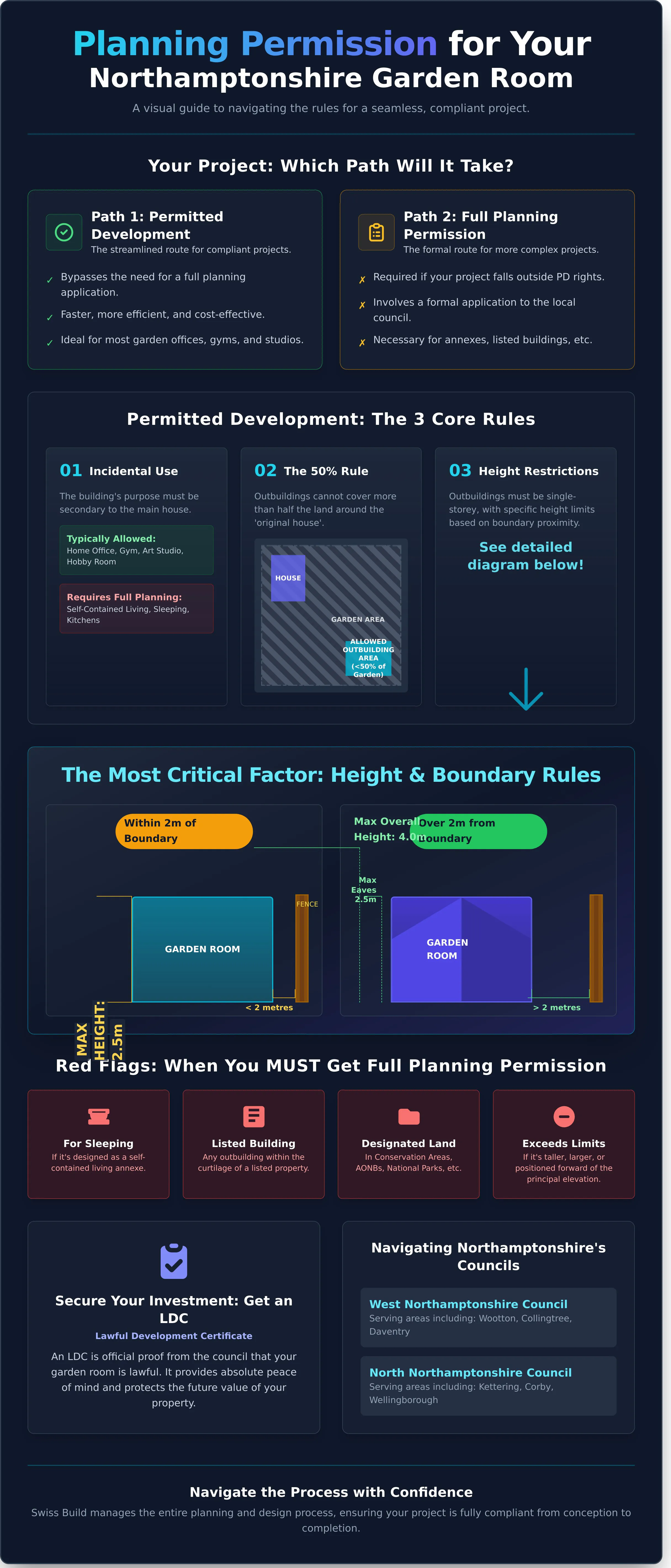
To qualify as Permitted Development, a garden room must adhere to a strict set of national criteria. These are not guidelines; they are absolute requirements that dictate the project’s size, position, and function. Swiss Build ensures every design is engineered from the ground up to meet these exacting standards. The core rules include:
- Incidental Use: The structure’s purpose must be ‘incidental’ to the enjoyment of the main dwelling. A home office, gym, art studio, or relaxation space typically qualifies. It cannot be designed as self-contained living accommodation with a kitchen or bathroom, as this would constitute a separate dwelling.
- Height Restrictions: Outbuildings must be single-storey. The maximum eaves height (the point where the wall meets the roof) is capped at 2.5 metres if the structure is within two metres of a boundary.
- The ‘50% Rule’: The total area of all sheds, garden rooms, and other outbuildings cannot occupy more than 50% of the total land around the ‘original house’ (as it was first built or as it stood on 1st July 1948).
Northamptonshire’s Local Planning Authorities (LPAs)
While PD rights are granted nationally, their interpretation and enforcement fall to local councils. Northamptonshire is served by two distinct Local Planning Authorities (LPAs). For residents in areas like Wootton, Collingtree, and Daventry, navigating the West Northants planning portal is the first step. Conversely, homeowners in Kettering, Corby, and Wellingborough must engage with the specific local plan nuances of North Northants Council. Although both operate within the same national UK planning permission framework, local conditions, such as conservation areas or listed building curtilages, can introduce specific constraints. Our expertise lies in managing these local details, providing you with absolute peace of mind that your project is fully compliant from conception to completion.
The 2.5m Height Rule and Boundary Restrictions
Navigating the regulations for a garden room often begins and ends with two critical measurements: height and proximity to your property’s boundary. Under Permitted Development rights, these factors are intrinsically linked. A miscalculation of just a few centimetres can be the difference between a seamless project and a costly planning dispute. It’s a landscape of fine margins where precision is not a luxury, but a fundamental requirement.
The most pivotal regulation is the 2-metre boundary rule. Any part of your garden room that is within 2 metres of a boundary fence or wall cannot exceed an overall height of 2.5 metres (approximately 8 feet 2 inches). This single constraint dictates the design, roof style, and placement of most garden buildings in the UK. Many self-build projects fail at this first hurdle, often due to a misunderstanding between ‘eaves height’ (where the wall meets the roof) and ‘overall height’ (the structure’s highest point). For a flat-roofed building, these are often the same, but for a pitched roof, the distinction is critical. These rules are detailed in the government’s official guidance on outbuildings, yet their application to a specific site requires careful, professional assessment.
At Swiss Build Ltd, our design process begins with a meticulous site survey where we establish these parameters with absolute certainty. We verify the ‘original’ ground level, as this is the only baseline your local council will accept; recently installed patios or decking do not alter this measurement. This rigorous approach ensures our designs comply with the 2.5m threshold from the outset, eliminating the risk of future compliance issues.
Roof Types and Their Height Limits
The 2.5m height restriction directly influences your choice of roof. For structures positioned near a boundary, a flat or mono-pitched roof is the industry standard, ensuring the entire building remains compliant. However, if your garden allows the structure to be placed more than 2 metres from every boundary, your design options expand. In this scenario, a dual-pitched roof can reach an overall height of 4 metres, with the eaves remaining at 2.5 metres. This boundary proximity is the number one reason Northamptonshire homeowners are forced to modify ambitious designs post-consultation.
The 50% Land Coverage Calculation
Beyond height, you must consider the total footprint of all outbuildings. Permitted Development dictates that all outbuildings, including your proposed garden room, must not cover more than 50% of the total land area around your house. This area, known as the ‘curtilage’, is the land you own excluding the footprint of the original dwelling. Calculating this requires you to account for every existing structure: sheds, greenhouses, summerhouses, and even previous extensions. Overlooking a forgotten shed can inadvertently push your project over the 50% limit, triggering the need for a full planning application. This is precisely why a bespoke design is superior to an off-the-shelf kit; our architects can design a garden room that maximises your available space without breaching these strict coverage limitations, ensuring your project proceeds smoothly.
When Your Garden Room Requires Full Planning Permission
While Permitted Development rights offer considerable freedom for homeowners, they are not absolute. Certain project characteristics and property designations immediately void these rights, requiring a more formal, comprehensive approach through a full planning application. Understanding these critical thresholds is the first step in a seamless and compliant build. For discerning clients, navigating the rules for planning permission garden room northamptonshire is a matter of precision, not chance.
Crossing one of these lines without the correct permissions can lead to costly enforcement action. We ensure this never happens by meticulously assessing every project against four key triggers: residential use, listed building status, conservation area rules, and other special designations.
Sleeping Accommodation and Residential Annexes
The moment a garden room is intended for sleeping, it legally ceases to be an ‘outbuilding’. Its purpose shifts from ‘incidental’ use, such as a home office or gym, to ‘ancillary’ living accommodation. A structure containing a bedroom or even just a shower room is often considered a self-contained living unit, a classification that demands a full planning application and must satisfy the far more stringent Building Regulations for habitation. The distinction is a fine but critical one, detailed within the government’s official technical guidance on the matter.
At Swiss Build, our design process meticulously navigates these regulations. We create bespoke, multi-functional spaces that serve your lifestyle-perhaps an office with a convenient WC and kitchenette-without crossing the legal line into primary accommodation, ensuring your project proceeds with efficiency and certainty.
Heritage and Landscape Constraints
Northamptonshire’s rich architectural heritage and stunning landscapes impose specific planning controls that supersede standard Permitted Development rights. If your property is listed, lies within a Conservation Area, or is designated as an Area of Outstanding Natural Beauty (AONB), the rules become uncompromising.
- Listed Buildings: Any new structure built within the curtilage of a Grade II listed manor house near Towcester, for example, will require both full planning permission and Listed Building Consent. The design must be demonstrably subservient and complementary to the historic setting.
- Conservation Areas: In protected districts such as Abington and Dallington in Northampton, or the historic village centres around Oundle, you cannot place a garden room to the side of your property. All designs must use sympathetic materials and proportions to preserve the area’s unique character.
- AONB & Article 4 Directions: For properties on the edge of the Cotswolds AONB, or in areas where West Northamptonshire Council has issued an Article 4 Direction to remove PD rights, every detail from the cladding to the roofline is subject to intense scrutiny.
This is where our expertise becomes your peace of mind. As part of our end-to-end service, we manage the entire application process, including the preparation of detailed Heritage Statements and compelling design justifications. We ensure your new garden room not only meets your vision but also respects and enhances its privileged surroundings.
The Lawful Development Certificate: Your ‘Peace of Mind’ Document
While many garden rooms fall under Permitted Development rights, proceeding without official confirmation leaves a degree of ambiguity. For a discerning homeowner investing in a bespoke garden building, ambiguity is unacceptable. This is where a Lawful Development Certificate (LDC) becomes the gold standard. It is not planning permission; rather, it’s a formal, legally binding confirmation from your local council that your project is lawful and does not require it.
Think of it as the ultimate due diligence. When you eventually sell your Northamptonshire home, the buyer’s solicitor will meticulously scrutinise any additions to the property. An LDC pre-empts all questions, providing irrefutable proof of compliance and ensuring a smooth, uncomplicated conveyancing process. Without it, you could face last-minute valuation disputes or even delays that jeopardise the entire sale. An LDC transforms your garden room from a beautiful feature into a certified asset.
The LDC Application Process
Securing an LDC from West Northamptonshire or North Northamptonshire Council is a formal legal process that demands precision. A successful application requires a meticulous submission of evidence, typically including:
- Scaled Architectural Drawings: Detailed floor plans and elevations showing the exact dimensions and appearance of the proposed structure.
- Ordnance Survey Site Plan: A plan clearly marking the property boundary and the precise location of the garden room in relation to the main dwelling and its borders.
- A Statement of Use: A clear declaration that the building’s use is incidental to the enjoyment of the main house (e.g., home office, gym, studio) and not for self-contained living.
The councils have a statutory 8-week period to issue a decision, which is why we advise initiating this process well before breaking ground. Submitting an application is not about negotiation; it’s about presenting sufficient, unambiguous evidence that your project meets every criterion for permitted development. This is a key part of the formal process for obtaining certification for a planning permission garden room northamptonshire project that is designed to be compliant from the outset.
Building Regulations for Garden Rooms
It’s crucial to distinguish planning rules from Building Regulations. The former governs what you can build and where, while the latter dictates how it must be built to ensure safety, thermal efficiency, and structural integrity. For garden rooms, specific size thresholds apply:
- Under 15sqm: Generally exempt, provided there is no sleeping accommodation.
- 15sqm to 30sqm: Exempt if it contains no sleeping accommodation and is either constructed substantially of non-combustible materials or is located at least one metre from any boundary.
- Over 30sqm: Will always require a formal Building Regulations application.
Independently of size, any garden room containing plumbing or a mains electricity connection must comply with the relevant sections of the Building Regulations. All electrical work, without exception, must be designed, installed, and certified by a Part P registered electrician to guarantee safety. This is a non-negotiable aspect of a professional build.
Ultimately, an LDC provides legally binding proof that your garden room did not require planning permission at the time of construction. It is the definitive document that secures your investment. For a seamless process that integrates architectural design with meticulous legal compliance, explore our turnkey garden room solutions.
Navigating the Process with Swiss Build’s Turnkey Service
Understanding the regulations is one challenge; executing a project that satisfies them without compromising on design is another entirely. At Swiss Build, our philosophy is founded on the principle that architectural beauty and rigorous technical compliance are not opposing forces, but two sides of the same coin. We provide a comprehensive, end-to-end service designed to absorb the complexities of planning and construction, leaving you with nothing but the certainty of an exceptional result.
Our approach transforms the often-anxious journey of securing planning permission for a garden room in Northamptonshire into a seamless, managed process. From the initial site assessment to the final council sign-off, our team assumes total accountability. We believe that bespoke craftsmanship is the only way to meet the exacting standards of local planning authorities while creating a space that is a true extension of your home and lifestyle. This isn’t just about building a structure; it’s about delivering a meticulously planned, flawlessly executed architectural asset.
The Feasibility Study
Our process begins with a meticulous feasibility study, the bedrock of a successful project. We conduct a thorough analysis of your property’s planning history, identifying any potential constraints such as Article 4 Directions or restrictive covenants hidden within your deeds. This initial diligence allows us to design a garden room that honours your lifestyle aspirations while respecting the critical 2.5m height discipline for permitted development, ensuring a smooth path through regulations where possible.
Precision Execution and Final Handover
True quality is often invisible. It resides in the details that ensure longevity and comfort: the U-values of the insulation, the integrity of the structural frame, and the effectiveness of the drainage solution. Our commitment to this ‘invisible quality’ is uncompromising. Every Swiss Build project is delivered with a fixed-price quote, eliminating financial uncertainty, and managed with a systematic discipline that ensures we complete our work on schedule. This is the steady hand required for complex builds, providing peace of mind from start to finish.
Ready to transform your garden with a space defined by precision and elegance? Your journey begins with a conversation. Discover our bespoke garden room gallery and book your Northamptonshire consultation to start your meticulous planning journey today.
Bring Your Vision to Life: Your Next Steps in Northamptonshire
Navigating the 2026 regulations for your garden room can feel complex. The key is understanding how Permitted Development rights, particularly the 2.5m height rule, apply to your property. Securing a Lawful Development Certificate isn’t just paperwork; it’s the definitive assurance that your investment is compliant and protected. Mastering these details is fundamental to a successful planning permission garden room northamptonshire project.
You don’t have to manage this alone. At Swiss Build, we translate regulatory complexity into a seamless, turnkey experience. With 26+ years of industry experience, we provide meticulous, full project management from concept to completion, all underpinned by our fixed-price residential construction guarantee. We handle every detail, so you can focus purely on the vision.
Secure your bespoke garden room with Swiss Build’s end-to-end planning service and allow our expertise to bring your vision to life with absolute precision and peace of mind.
Frequently Asked Questions
Is 2.5m high enough for a comfortable garden office in Northampton?
Yes, a 2.5m external height is perfectly sufficient for a luxurious and functional garden office. This specific height is the maximum allowed under Permitted Development rules when building within two metres of a boundary. After factoring in a robust base and a meticulously engineered roof structure, this provides an internal ceiling height of approximately 2.1m. This creates a spacious, comfortable environment for focused work, without compromising on design or comfort.
Can I have a toilet and sink in my garden room without planning permission?
Yes, installing plumbing facilities like a toilet and sink is generally permissible without full planning permission. Such amenities are considered incidental to the main dwelling. However, it’s crucial to understand that connecting to the mains drainage system falls under UK Building Regulations. This is a separate but mandatory approval process that ensures all work meets exacting safety and technical standards, a detail we manage seamlessly for our clients.
How close to my neighbor’s fence can I build my garden studio in Northants?
You can build your garden studio directly adjacent to a boundary fence. The critical regulation is that any part of the structure built within two metres of a boundary must not exceed an overall height of 2.5 metres from the original ground level. This rule allows for efficient use of your garden space while respecting planning constraints. For structures positioned more than two metres away, greater heights are often achievable under Permitted Development.
What happens if I build a garden room that breaches Permitted Development rules?
If your structure violates Permitted Development criteria, the local authority, such as West Northants Council, can issue an enforcement notice. This legal order may compel you to make costly alterations to achieve compliance or, in the worst-case scenario, require complete demolition of the building. The council has up to four years to take such action. Securing a Lawful Development Certificate beforehand provides absolute certainty and mitigates this significant risk.
Does a garden room increase my Council Tax in Northamptonshire?
A garden room will not typically increase your Council Tax, provided its use remains incidental to the main house. Uses like a home office, gym, or art studio do not affect your council tax band. The situation changes if the building becomes self-contained living accommodation with full sleeping and cooking facilities. In such cases, the Valuation Office Agency (VOA) could classify it as a separate dwelling, which would then attract its own Council Tax liability.
Do I need planning permission for a garden room if I live in a Conservation Area?
Yes, if your Northamptonshire property is within a designated Conservation Area, planning permission is almost always required. Permitted Development rights are significantly restricted in these protected locations. For instance, any garden building situated to the side of your property will require a full planning application. Structures at the rear are also subject to much stricter limitations than in non-designated areas, demanding a meticulous and considered approach to the planning process.
How long does it take for West Northants Council to approve a Lawful Development Certificate?
The statutory timeframe for a local authority to determine an application for a Lawful Development Certificate (LDC) is eight weeks from the point of validation. While West Northants Council aims to meet this target, complex cases or high application volumes can occasionally extend the process. An LDC provides definitive legal proof that your project is lawful, offering invaluable peace of mind and simplifying any future property sale. It’s a prudent investment in certainty.
Can I use my garden room as a guest bedroom occasionally?
Using a garden room for any form of sleeping accommodation, even occasionally, is a significant planning consideration. The structure’s primary purpose must remain “incidental” to the enjoyment of the main house. Regular use as a bedroom can be interpreted as creating a separate dwelling, which falls outside Permitted Development. This would require full planning permission for a garden room in Northamptonshire to be lawful and avoid potential enforcement action from the council.