
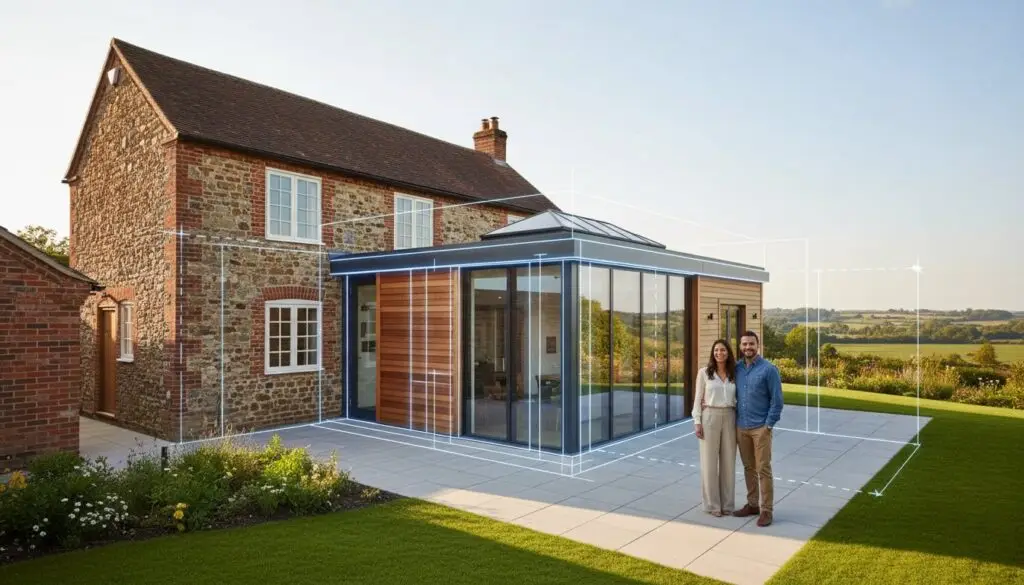
Your dream extension could become a significant legal liability overnight if a single technical measurement deviates by just 100 millimetres from the prescribed limits. You likely feel that the UK planning system is a labyrinth designed to stifle architectural ambition rather than facilitate it. This anxiety is justified. In 2024, local authorities across England issued thousands of enforcement notices for works that failed to meet the strict criteria of the General Permitted Development Order. It’s natural to worry that incorrect paperwork might compromise your property’s resale value or invite unwanted council scrutiny.
This guide ensures your 2026 project is built on a foundation of absolute legal certainty and uncompromising precision. You’ll master the complexities of permitted development rights extensions to extend your Northampton home with a bespoke design that adheres to every technical nuance. We provide a meticulous roadmap for your renovation, detailing exact height and depth constraints while securing your peace of mind through a Lawful Development Certificate. By the end of this article, you’ll have the confidence to move from a conceptual vision to a seamless, turnkey execution.
Key Takeaways
- Understand how to leverage Parliament’s implied permissions to bypass traditional planning routes for a more efficient and streamlined build process.
- Master the critical technical limits, from curtilage percentages to ridge height ratios, required to maintain architectural integrity without formal permission.
- Identify how local heritage protections and Article 4 Directions influence permitted development rights extensions within specific Northamptonshire postcodes.
- Learn the essential role of the Lawful Development Certificate in providing the definitive legal proof needed for property valuations and future sales.
- Discover the Swiss Build Ltd methodology for marrying technical compliance with uncompromising luxury through a disciplined, turnkey project management approach.
Understanding Permitted Development Rights for Extensions in Northampton
Permitted Development (PD) represents a statutory instrument that grants an implied planning permission by Parliament, allowing homeowners to bypass the traditional full application process. This right is derived from the General Permitted Development Order, a foundational piece of legislation that ensures residential growth remains efficient and predictable. For discerning homeowners in Northamptonshire, permitted development rights extensions offer a streamlined alternative to the often subjective nature of full planning permission. It’s a route that rewards precision and architectural discipline.
The framework relies heavily on the concept of the “original house.” This term specifically refers to the property as it stood on 1 July 1948 or, if it was built after this date, as it was originally constructed. Any additions made by previous owners since 1948 are deducted from your total allowance. As we look toward 2026, national policy continues to favour residential expansion across the East Midlands. The government’s ongoing commitment to simplifying the planning system ensures that these rights remain a robust tool for those seeking to enhance their living space with absolute certainty.
Does Your Property Qualify for PD Rights?
PD rights apply specifically to houses. Flats, maisonettes, and other buildings don’t share these same privileges. If your property is a detached home in areas like Wootton or a semi-detached residence in Abington, you likely possess these rights unless they’ve been restricted. It’s essential to verify if West Northamptonshire Council has issued an Article 4 Direction on your street. Such directions can revoke PD rights to preserve the character of specific conservation areas. We also meticulousy check the history of the site, as a previous extension might have already exhausted your remaining volume allowance.
The Strategic Benefits of the PD Route
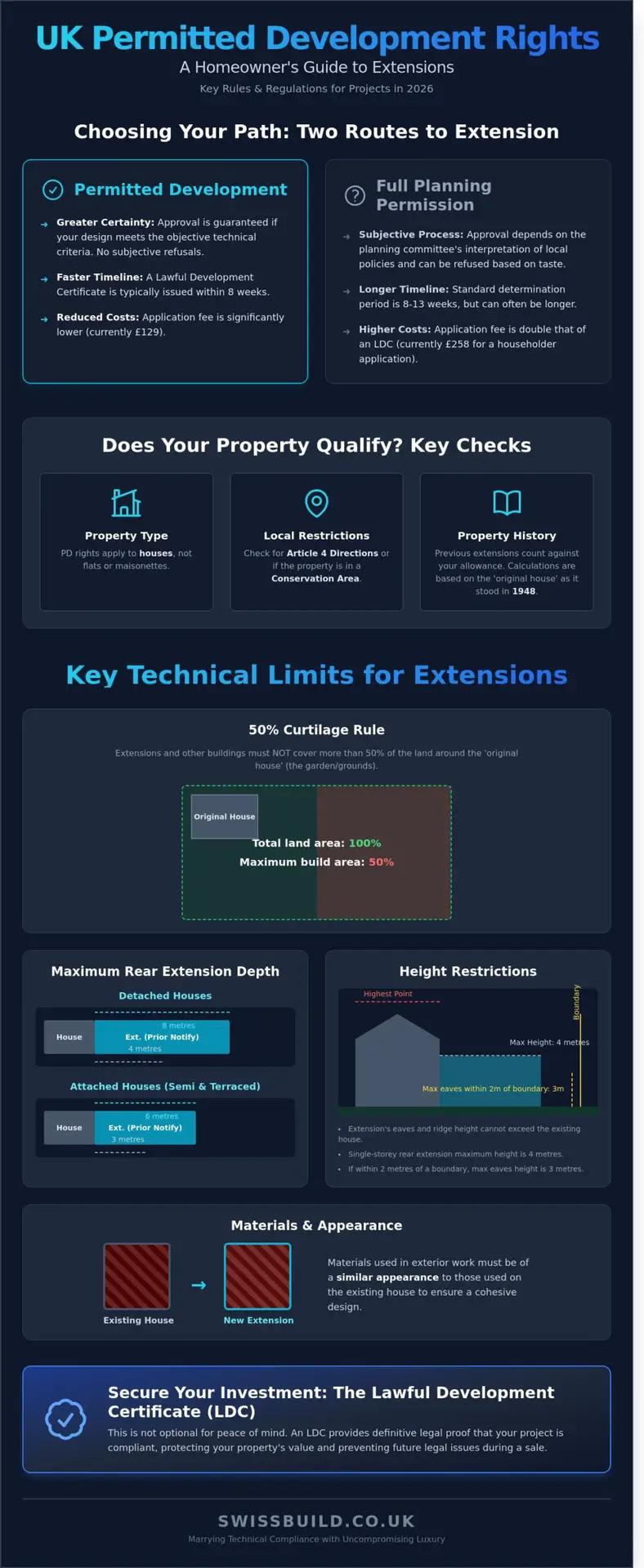
Choosing the PD route offers a level of administrative efficiency that full planning applications rarely match. The primary benefit is the reduction in timelines. By applying for a Lawful Development Certificate (LDC), you receive a legally binding document confirming your project is lawful, usually within 8 weeks. This provides a seamless transition from design to construction.
- Greater Certainty: If your design fits the technical criteria, the council cannot refuse the application based on subjective taste.
- Reduced Costs: Application fees for a Lawful Development Certificate are currently £129, compared to £258 for a full householder application.
- Bespoke Precision: The strict technical parameters of PD encourage a disciplined approach to architecture, resulting in extensions that are both functional and aesthetically balanced.
This methodical approach ensures that your vision for a high-end extension is realised without the anxieties of a discretionary planning committee. It’s a turnkey strategy for those who value professional authority and technical mastery in their home improvements.
Technical Limits: What Can You Build Without Planning Permission?
Achieving a seamless addition to your home requires a disciplined understanding of the General Permitted Development Order. The primary constraint is the 50% curtilage rule. You cannot cover more than half the area of land around the original house with extensions or outbuildings. This calculation excludes the footprint of the original dwelling, which is defined by its status on 1 July 1948 or as it was first built. Precision is paramount here; exceeding this limit by even a small margin can lead to enforcement action.
To maintain architectural integrity, the permitted development rights for extensions mandate that materials must be of a similar appearance to the existing structure. This isn’t just a legal requirement. It’s the foundation of a cohesive design that preserves the property’s character. Other technical limits include:
- Height Restrictions: The eaves and ridge height cannot exceed those of the existing house. If the extension is within 2m of a boundary, the eaves height is capped at 3m.
- Side Extensions: These are restricted to a single storey. Their width must not exceed 50% of the original house’s width.
- Verandas and Balconies: These features are strictly excluded from permitted development rights extensions and always require a full planning application.
Single-Storey Rear Extensions: The 2026 Rules
The 2026 regulatory environment maintains specific depth limits based on your property type. Semi-detached houses are limited to a 3m depth, while detached homes enjoy a 4m allowance. For those seeking more substantial growth, the Prior Approval larger home extension scheme remains a vital tool. This allows for depths up to 8m for detached houses and 6m for others, subject to a neighbour consultation process. Total height is restricted to 4m to prevent overshadowing.
Double-Storey Extensions and Loft Integration
Two-storey additions require a more meticulous approach to boundary distances and light. They can extend up to 3m from the rear wall, provided they sit at least 7m from the rear boundary. To protect local privacy, upper-floor windows in a side elevation must be obscure-glazed and non-opening unless the parts that open are more than 1.7m above the floor. Many clients choose to integrate these projects with bespoke loft conversions. This dual strategy maximises both vertical and horizontal space within a single, systematic build phase. If you’re unsure how these limits apply to your specific plot, our team at Swiss Build can provide a technical feasibility assessment.
Local Restrictions: Conservation Areas and Article 4 Directions
Northamptonshire’s architectural heritage is a source of immense pride, yet it introduces a layer of complexity for those exploring permitted development rights extensions. While national legislation offers a general framework, local authorities frequently intervene to safeguard the aesthetic continuity of the county’s most significant areas. It’s a necessary discipline that ensures the character of our villages and towns remains untarnished by unsympathetic additions.
In specific residential pockets, such as the Victorian corridors surrounding Abington Park or the historic heart of Wootton, West Northamptonshire Council may implement an Article 4 Direction. This legal tool removes specific PD rights that would otherwise be available. It means that even minor alterations, which usually wouldn’t require a second thought, must undergo a full planning assessment. Homeowners must stay informed on the Latest government consultation on permitted development to see how these local powers are being refined to meet modern housing demands. Within Areas of Outstanding Natural Beauty (AONB), the rules are even more stringent; the volume of an extension is often capped at a lower threshold than standard properties to protect the natural landscape.
Building in Northampton Conservation Areas
The conservation zones in Kingsthorpe and Moulton are defined by their strict adherence to historical form. In these areas, permitted development rights extensions are curtailed to prevent the loss of architectural rhythm. Side extensions almost always necessitate full planning permission here. The council demands a meticulous match in materials, from the specific hue of the ironstone to the profile of the roof tiles. This ensures every new structure feels like a natural evolution of the streetscape rather than an intrusion.
Listed Buildings and Heritage Assets
For Grade I and Grade II listed properties, permitted development rights don’t apply. Any structural change requires Listed Building Consent, a process that demands absolute transparency and technical mastery. Historic England data from 2023 indicates there are over 370,000 listed entries across the country; many of these are located within Northamptonshire’s rural estates. Swiss Build provides a bespoke, turnkey solution for these sensitive projects. We balance the requirements of heritage officers with the desire for modern luxury, ensuring that every intervention is executed with uncompromising precision and respect for the building’s original soul.
The Path to Compliance: Lawful Development Certificates
Building under permitted development rights extensions doesn’t mean building without formal accountability. Relying on an “implied” right is a gamble that high-end homeowners cannot afford to take. A Lawful Development Certificate (LDC) is the only definitive legal document that confirms your project is compliant with the General Permitted Development Order. It transforms a subjective interpretation of planning law into an objective, legally binding fact.
Without this certificate, your investment remains vulnerable. If a local authority determines that your build exceeded its limits by even a few millimetres, they can issue an Enforcement Notice. This legal action can mandate the total demolition of the structure. In 2026, property conveyancing has become even more data-driven. Solicitors representing future buyers will demand an LDC as part of their due diligence. Failing to produce one can stall a high-value sale or lead to significant price renegotiations. It’s the ultimate proof of a legal build, ensuring your property’s value is protected for the long term.
Applying for an LDC in West Northamptonshire
The application process within West Northamptonshire requires a disciplined approach to documentation. You must provide meticulous architectural drawings, 1:1250 scale site plans, and technical specifications that prove your extension fits within the prescribed limits. For 2026, the local planning department typically operates on an eight-week statutory timeline for determination. Securing this certificate provides a level of peace of mind that is essential for bespoke residential investments. It removes the anxiety of future disputes with neighbours or local officials, allowing you to focus on the aesthetic execution of your vision.
PD vs. Building Regulations: A Critical Distinction
It’s a common misconception that planning compliance equals structural compliance. Permitted development rights only cover the principle of whether you can build. They don’t address how the structure is actually put together. You must still satisfy the mandatory building regulations in Northamptonshire to ensure the safety and longevity of the work.
- Thermal Performance: Your extension must meet 2026 Part L standards for energy efficiency, focusing on high-performance glazing and insulation.
- Fire Safety: Compliance with Part B is non-negotiable, particularly regarding escape routes and internal fire spread.
- Structural Integrity: Detailed calculations must be submitted to verify that the foundations and load-bearing elements are fit for purpose.
To ensure your project meets every legal and technical benchmark without compromise, consult with our project management team today.
Executing Your Vision with Swiss Build Precision
Understanding the complexities of permitted development rights extensions requires a partner who balances regulatory rigour with architectural elegance. Swiss Build provides a comprehensive, turnkey solution that manages every variable of your project. With 26 years of heritage in high-end construction, we’ve refined a process that eliminates the friction often found in residential renovations. Our team takes full accountability for the journey, from the initial verification of your PD rights to the final, bespoke interior fit-out. This end-to-end management ensures that the structural integrity of your home matches the luxury of its design.
Our philosophy is rooted in the marriage of technical mastery and uncompromising quality. We don’t believe in shortcuts. Every brick laid and every beam installed serves a dual purpose: to enhance the functionality of your living space and to elevate its aesthetic value. By maintaining a steady, methodical pace, we provide the calm expertise required to execute complex visions without error.
The Meticulous Design and Build Journey
The process begins with conceptual visioning, where we align your lifestyle requirements with the technical possibilities of your site. We coordinate directly with structural engineers and local planning officers to ensure your permitted development rights extensions are fully compliant before construction commences. By meticulously managing the home extension timeline, we maintain disciplined punctuality. This systematic approach ensures your vision transitions from a sketch to a reality without unnecessary delays or logistical hurdles.
Why Northamptonshire Trusts Swiss Build
Discerning homeowners across the county choose us for our commitment to superior craftsmanship and transparent communication. We use only high-value materials that stand the test of time, ensuring your investment yields both aesthetic and financial dividends. Financial certainty is a priority, which is why we provide fixed-price residential construction fees at the outset. This eliminates the anxiety of escalating costs and allows you to focus on the transformation of your property.
- Direct Accountability: We handle every phase, from PD verification to the final coat of paint.
- Fixed-Price Fees: Transparent pricing structures that protect your budget from the start.
- Expert Heritage: Over two decades of experience building to an exacting standard.
- Seamless Communication: Regular updates that keep you informed at every project milestone.
We believe a beautiful space is only successful if it’s built to a precise technical standard. Our reputation in Northamptonshire is built on this invisible quality. We transform properties into stunning, functional masterpieces that reflect the unique character of their owners. Whether you’re seeking a contemporary glass-led extension or a traditional masonry addition, our disciplined execution ensures a result that is both aspirational and deeply practical.
Transforming Your Northampton Residence with Precision
Navigating the complexities of permitted development rights extensions in 2026 requires more than just an architectural vision; it demands a rigorous adherence to technical limits and local Northamptonshire regulations. Securing a Lawful Development Certificate remains a critical step to ensure your investment is protected and fully compliant with current standards. At Swiss Build, we translate these intricate planning requirements into bespoke living spaces through a marriage of superior craftsmanship and systematic management.
With 26+ years of industry experience, our team provides the steady hand necessary to execute complex renovations without error. We remove the typical anxieties of high-end construction by offering fixed-price residential construction quotes and a full turnkey project management service. This end-to-end accountability ensures that every detail, from the initial conceptual vision to the final structural finish, meets our uncompromising standards for quality. For homeowners seeking a seamless transformation, partnering with a design and build company Northampton eliminates the fragmentation of working with multiple contractors and provides the unified responsibility that sophisticated projects demand. It’s about creating a space that’s as technically perfect as it is aesthetically stunning.
Book a Meticulous Consultation for Your Northampton Extension
We’re ready to bring your vision to life with the discipline and excellence your home deserves.
Frequently Asked Questions
Can I build a 6-metre rear extension under permitted development in 2026?
Yes, you can build a 6-metre rear extension on a semi-detached or terraced property in 2026 by utilising the Prior Approval process. This larger home extension scheme, which the government made permanent in May 2019, allows for extensions between 3 and 6 metres. You must submit a formal notification to your local authority before any work begins to ensure your permitted development rights extensions are lawfully exercised.
Do I need to notify my neighbours if I am building under permitted development rights?
You don’t need to notify neighbours for standard extensions under 3 metres, but the Prior Approval scheme for larger projects requires a mandatory consultation. Once you submit your application for permitted development rights extensions, the council serves a notice to adjoining owners, who have 21 days to raise objections. If a neighbour objects, the council evaluates the impact on their amenity before reaching a decision.
What happens if I build an extension that exceeds permitted development limits?
Building beyond the legal limits results in a breach of planning control, which often triggers an enforcement notice from your local council. This legal order can require you to demolish the non-compliant structure at your own expense. In 2023, local authorities across England issued over 3,500 enforcement notices. Such discrepancies also complicate future property sales, as solicitors require proof of lawful construction during the conveyancing process.
Is a Lawful Development Certificate the same as planning permission?
A Lawful Development Certificate (LDC) is a legal document confirming your project didn’t require planning permission at the time of construction. While planning permission is a request for authorisation to build, an LDC is prospective or retrospective proof of legality. It provides absolute peace of mind for homeowners and is essential for property valuations. Obtaining one ensures your bespoke project meets all technical standards without the uncertainty of a full application.
Are materials important for permitted development rights in Northamptonshire?
Materials are a critical component of compliance, as the General Permitted Development Order requires external finishes to be of a similar appearance to the existing dwelling. In Northamptonshire, this means matching the specific brickwork, stone, or render textures common to the local architectural heritage. Our meticulous approach ensures that every bespoke finish aligns with these regulations, maintaining the aesthetic integrity of your home while adhering to strict legal requirements.
Can I use permitted development for a two-storey extension on a semi-detached house?
You can build a two-storey rear extension on a semi-detached house if it doesn’t extend more than 3 metres beyond the original rear wall. The structure must be at least 2 metres from the property boundary to comply with height restrictions. Additionally, the roof pitch must match the existing house to ensure architectural continuity. This systematic approach allows for significant space expansion while maintaining a seamless transition between the old and new structures.
Does permitted development cover the Party Wall Act requirements?
Permitted development rights only cover planning law and don’t exempt you from the requirements of the Party Wall etc. Act 1996. If your extension involves excavating within 3 or 6 metres of a neighbour’s structure, you must serve a formal notice at least one or two months before starting. We manage these complex legal intersections with professional authority, ensuring your project proceeds without the delays associated with civil disputes or boundary disagreements.
How long does it take to get a Lawful Development Certificate from West Northamptonshire Council?
West Northamptonshire Council typically aims to issue a decision on a Lawful Development Certificate within 8 weeks of receiving a valid application. This statutory timeframe is consistent across most UK local authorities, though complex cases may occasionally require an extension. Our disciplined project management ensures that all documentation is submitted with uncompromising precision, reducing the likelihood of delays during the council’s review process.