

What if the most critical element of your home renovation wasn’t the architectural design, but the invisible framework of rules that ensures its longevity and safety? Embarking on a bespoke home extension is a thrilling prospect. Yet, for many homeowners, this excitement is often tempered by the intricate and frequently confusing world of building control, especially with the administrative split between West and North Northamptonshire councils.
This guide is designed to replace that uncertainty with absolute clarity. We will provide a definitive roadmap for navigating the building regulations Northamptonshire requires for 2026, ensuring your project not only achieves aesthetic perfection but is founded on uncompromising principles of safety and structural integrity. From distinguishing planning permission from building control to understanding the inspection process and selecting a partner who manages the entire turnkey solution, consider this your essential blueprint for a seamless and fully compliant build.
Key Takeaways
- Grasp the fundamental distinction between planning permission and building regulations northamptonshire to ensure your project is both legally compliant and structurally sound.
- Clarify how Permitted Development rights apply to your home, enabling you to build without planning but still requiring full building control adherence.
- Evaluate the critical differences between a Full Plans Application and a Building Notice to select the most efficient path for securing council approval.
- Discover the specific technical standards for popular projects, from foundation depths for extensions to fire safety protocols for bespoke loft conversions.
Understanding Building Regulations in Northamptonshire: The Homeowner Essentials
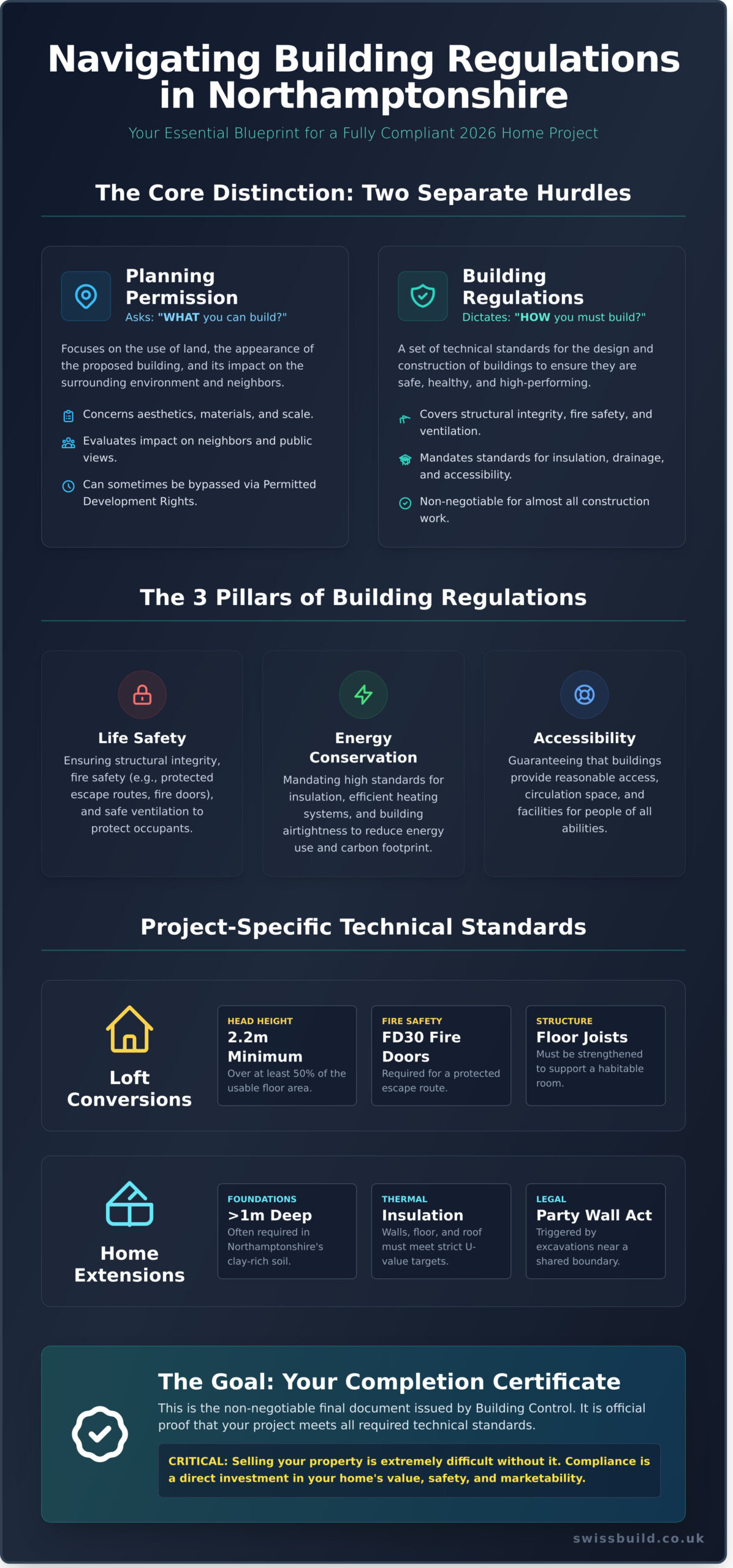
Embarking on a home renovation or a new build is a significant undertaking. For discerning homeowners, the path to a beautifully realised vision is paved with precision and adherence to standards. A common point of confusion, however, lies in distinguishing between Planning Permission and Building Regulations. Planning Permission concerns the aesthetic impact and use of land; it’s about whether you are permitted to build. Building Regulations, in contrast, are about the technical execution; they dictate how your project must be built to ensure it is safe, efficient, and accessible.
In our county, the enforcement of these standards is managed by two primary bodies: West Northamptonshire Council and North Northamptonshire Council. Navigating the specific requirements of building regulations northamptonshire is a non-negotiable step in any legitimate construction project. The core purpose of this oversight is not to create bureaucratic hurdles, but to safeguard homeowners and the public. This is achieved by focusing on three essential pillars of construction:
- Life Safety: Ensuring structural integrity, fire safety measures, and safe ventilation to protect occupants from harm.
- Energy Conservation: Mandating standards for insulation, efficient heating systems, and airtightness to reduce energy consumption and environmental impact.
- Accessibility: Guaranteeing that buildings are designed to provide reasonable access and facilities for people with disabilities.
These local authorities are responsible for enforcing the national standards set out by the Building regulations in the United Kingdom, ensuring every project meets a minimum benchmark for quality. The process culminates in a crucial document: the completion certificate. Without this certificate, selling your property becomes exceptionally difficult, as solicitors will halt the transaction until proof of compliance is provided.
The Role of Local Authority Building Control (LABC)
Your project will be inspected by either the Local Authority Building Control (LABC) or a private Approved Inspector. Both work to ensure national standards are met. The LABC operates as a non-profit function of the council, providing impartial advice. At Swiss Build, we champion early and collaborative engagement with building control officers. This proactive dialogue ensures a seamless process, resolving complex technical details long before they become on-site challenges and guaranteeing a smooth path to final certification.
Why Compliance is a Value-Add for Northampton Homes
Adhering to building regulations is not merely a legal formality; it’s a direct investment in your property’s future value and security. Meticulous compliance prevents latent structural defects that could lead to costly failures years down the line. In competitive property markets like Wootton and Abington, a full set of compliance certificates significantly enhances a home’s valuation and marketability. Furthermore, undertaking uncertified work can invalidate your home insurance, leaving you financially exposed should an incident, such as a fire caused by non-compliant wiring, occur. For those undertaking a wider property refurbishment Northampton project, ensuring every element of the transformation is fully compliant from the outset is the cornerstone of protecting both your investment and your home’s long-term value.
Project-Specific Regulations for Extensions, Lofts, and Garden Rooms
Embarking on a significant home transformation, whether an extension, loft conversion, or bespoke garden room, requires a deep understanding of project-specific building regulations. While distinct from planning permission, these technical standards are non-negotiable, ensuring your new space is safe, efficient, and structurally sound. It’s a common misconception to conflate the two; the UK Government’s guidance on planning permission and building regulations clearly separates aesthetic approval from technical compliance. Here, we detail the exacting standards applied to the most sought-after home additions.
For bespoke loft conversions, creating a habitable room involves more than just aesthetics. Head height is critical; building control typically requires a minimum of 2.2 metres over at least 50% of the usable floor area. Fire safety is paramount, often mandating the installation of FD30-rated fire doors and a protected escape route. For homeowners considering this transformative project, our comprehensive guide to loft conversions Northampton provides detailed insights into navigating these complex requirements while achieving exceptional results. Home extensions present different challenges, particularly concerning foundation depth. In areas with clay-rich soil, common across Northamptonshire, foundations may need to be excavated to depths exceeding 1 metre to prevent future movement. Any excavation near a shared boundary will also trigger the Party Wall etc. Act 1996, a separate but related legal requirement.
Even ancillary structures like garden rooms are subject to scrutiny. An outbuilding is generally exempt if its internal floor area is under 15m² and it contains no sleeping accommodation. However, building control approval becomes mandatory if the structure exceeds 30m², is positioned within one metre of a boundary and is built of combustible materials, or includes a bathroom. For those considering a high-end addition that transcends basic outbuilding standards, our guide to bespoke garden rooms in Northampton explores the architectural precision required to create a year-round space with the same thermal integrity as your primary residence. Similarly, a kitchen renovation, while seemingly internal, must adhere to Part F (Ventilation), requiring mechanical extraction rates of at least 60 litres per second over the hob, and Part P (Electrical Safety), which dictates that all new circuits must be installed and certified by a registered electrician.
Structural Integrity and Fire Safety Standards
Any project involving the removal of a load-bearing wall or the creation of a new upper floor necessitates meticulous structural planning. The installation of steel beams (RSJs) requires precise calculations from a qualified structural engineer, which must be submitted to building control for approval before work commences. For multi-storey renovations, fire safety protocols demand the installation of interconnected, mains-powered smoke alarms to provide simultaneous warning across all floors. For residential builds completed from 2026, Part B will mandate the inclusion of sprinkler systems in all new homes and blocks of flats over 11 metres in height.
Thermal Performance and Energy Efficiency (Part L)
The UK’s commitment to net-zero carbon emissions by 2050 has profoundly impacted building regulations, particularly Part L (Conservation of fuel and power). The 2025 Future Homes Standard sets demanding new targets for thermal performance. For new extensions in Northamptonshire, this translates to achieving superior insulation levels, with target U-values of 0.15 W/m²K for walls and 0.11 W/m²K for roofs. To ensure wall cavities are clear and properly prepared to meet these standards, you can check out CavClear. Glazing is also strictly controlled; if the total area of windows and rooflights exceeds 25% of the new floor area, a detailed SAP calculation is required to demonstrate that the design mitigates excessive heat loss. This focus on sustainability is also driving a shift toward low-carbon heating. Inspections of projects involving the building regulations northamptonshire authorities oversee now frequently assess the correct installation of systems like air source heat pumps, which must be fitted by an MCS-certified professional. Ensuring your design meets these forward-looking standards from the outset is a core part of our meticulous project management process.
Planning Permission vs. Building Regulations: The Northamptonshire Landscape
For homeowners embarking on a renovation or extension, the distinction between planning permission and building regulations is a critical, yet frequently misunderstood, hurdle. They are two separate legal frameworks with entirely different objectives. Planning permission governs what you can build; it’s concerned with the aesthetic impact on your community, its size, its use, and its relationship to neighbouring properties. Building regulations, conversely, dictate how you must build. This is a purely technical assessment to ensure the structure is safe, structurally sound, energy-efficient, and accessible. One approval does not imply the other, a common pitfall that can lead to significant delays and unforeseen costs, especially within the unique architectural context of Northamptonshire’s historic towns and villages.
When is Planning Permission Not Required?
Many smaller-scale projects, such as internal refurbishments, modest single-storey rear extensions, or loft conversions that don’t alter the existing roofline, may fall under “Permitted Development Rights.” These rights allow you to proceed without a full planning application. However, this freedom from the planning department does not grant exemption from the exacting standards of building regulations northamptonshire. Any structural alteration, from removing an internal wall to installing a new bathroom with updated drainage, requires building control approval. For absolute certainty and to avoid complications during a future property sale, obtaining a Lawful Development Certificate is a prudent investment. This document provides official confirmation that your project was lawful at the time of construction. Be mindful that local Article 4 directions, sometimes used in conservation areas across villages like Badby or Oundle, can restrict these rights to preserve the area’s distinct character.
The Danger of Proceeding Without Approval
Proceeding without the necessary approvals is a high-stakes gamble with severe financial and legal consequences. Local authorities possess robust enforcement powers, and an unauthorised build can result in a notice demanding costly remedial work or, in the worst-case scenario, complete demolition. The alternative, a retrospective “regularisation” application, is a stressful and expensive path. Application fees alone can be up to 50% higher than standard submissions, and this figure doesn’t include the substantial cost of opening up completed work for inspection. For a comprehensive overview of the correct application process, the West Northamptonshire Council Building Control website is an indispensable resource. DIY-led projects in the East Midlands frequently fail inspections on critical points like thermal insulation (Part L), fire safety measures (Part B), or ventilation (Part F), turning a dream project into a compliance nightmare that devalues your property.
At Swiss Build, we eliminate this risk entirely. Our meticulous, end-to-end project management philosophy integrates compliance from the very first architectural sketch. The seamless collaboration between our designers, structural engineers, and on-site managers ensures that every detail is scrutinised against current regulations. We navigate the complexities of both planning and building control on your behalf, ensuring every technical specification is met and every certificate is secured long before construction commences. This rigorous pre-construction discipline is the foundation of our promise: to deliver not just an aesthetically superior home, but one built to an uncompromising standard of technical excellence, providing you with absolute and lasting peace of mind.
The Step-by-Step Process of Securing Building Control Approval
Navigating the path to building control approval is a disciplined journey, not a bureaucratic maze. For a project to achieve technical excellence, its compliance must be as meticulously planned as its aesthetic. This systematic process ensures your home is not only beautiful but also safe, efficient, and structurally sound, culminating in the ultimate validation: a Final Completion Certificate.
Full Plans vs. Building Notice: Which is Right for You?
For any significant undertaking, such as a bespoke extension or a complex renovation, Swiss Build exclusively recommends a Full Plans Application. This approach involves submitting detailed architectural and structural drawings to the council for pre-approval before any work commences. It provides absolute certainty. The plans are professionally vetted against all relevant building regulations northamptonshire, guaranteeing compliance and locking in your project’s technical specifications. This meticulous preparation de-risks the entire construction phase and allows for a precise, fixed-price quotation. A Building Notice, conversely, involves a “build as you go” approach. While it allows work to start faster, it carries substantial risk. An inspector may identify non-compliant work only after it has been completed, forcing costly and disruptive corrections. The initial fee saving is often a false economy.
This digital-first approach to planning is becoming the industry standard. While individual home extensions don’t require urban-scale simulation, the same principles of detailed pre-visualization apply. Professionals in the wider development sector now rely on sophisticated software like 3D Cityplanner to model and analyze projects, ensuring compliance and efficiency before a single brick is laid.
In terms of budgeting, application fees for West and North Northamptonshire councils are based on project scope. For a typical single-storey extension, a Full Plans application fee, inclusive of all subsequent site inspections, generally falls between £800 and £1,200. This provides financial clarity from day one.
Booking Inspections in Northampton, Corby, and Kettering
Once your project is underway, a sequence of site inspections becomes the critical measure of progress and quality. Seamless coordination with your local building control officer in Northampton, Corby, or Kettering is paramount to avoid delays. We manage this dialogue, typically providing at least 48 hours’ notice for each required inspection. The inspector must sign off on key stages before the work is concealed, as rectifying errors at a later stage can be profoundly expensive.
The critical inspection stages include:
- Commencement: Notifying the council when work officially begins.
- Foundations: Inspection of the excavated trenches before concrete is poured.
- Oversite & DPC: Checking the hardcore, damp-proof membrane (DPM), and damp-proof course (DPC) before the floor is laid.
- Drainage: Testing all new drainage connections before they are backfilled.
- Superstructure: Assessing the structural elements like beams, columns, and the roof structure.
- Final Inspection: A comprehensive review upon completion.
The final inspection is a holistic assessment. The officer verifies everything from fire safety measures and ventilation to thermal insulation and access. A successful final inspection is the gateway to receiving your Completion Certificate, the “gold standard” document for your home. This certificate is indispensable for any future sale, remortgage application, or insurance validation. It is the official record that your project was executed to an exacting technical standard. Our end-to-end project management ensures every inspection is anticipated and passed, delivering not just a beautiful home but the certified peace of mind that comes with it. To discuss how we manage these intricate details for our clients, schedule your initial project consultation today.
Turning Regulations into Reality: The Swiss Build Approach
Understanding building regulations is one challenge; executing a project flawlessly within them is an entirely different discipline. For discerning homeowners, the complexities of compliance can overshadow the excitement of creating a new space. This is where a systematic, expert-led approach transforms a potentially stressful process into a seamless journey. At Swiss Build, our turnkey philosophy is designed to absorb this complexity entirely, managing every council interaction and technical requirement on your behalf.
With 26 years of dedicated experience in the region, we have cultivated an intimate understanding of Northamptonshire’s specific building landscape. This deep-rooted expertise allows us to navigate the local council’s requirements with precision and foresight. Our commitment is delivered through a fixed-price residential construction fee, a transparent agreement that encompasses our comprehensive project management. This isn’t an added service; it’s the fundamental structure of our promise, ensuring your project is managed with financial clarity and professional accountability from start to finish.
We believe that true craftsmanship begins where the code ends. While adherence to the building regulations northamptonshire sets the minimum standard for safety and performance, our internal benchmarks for quality are significantly higher. From the grade of timber in a structural frame to the tolerances in a bespoke kitchen installation, our standards are uncompromising. Compliance is our baseline, not our ambition.
Our Meticulous Project Management Process
We guide every project through a rhythmic, disciplined journey, from the first lines of a bespoke design to the final handshake. Our process is built on proactive integration, engaging structural engineers and building control officers from day one. This early collaboration ensures that innovative design is grounded in technical viability, eliminating unforeseen obstacles and securing a smooth path to approval. We maintain absolute transparency, providing you with regular, clear updates without the technical jargon, so you remain informed and confident at every stage. Understanding the precise home extension timeline UK requirements for 2026 is essential for managing expectations and ensuring your project progresses smoothly from concept to completion.
Why Discerning Homeowners Choose Swiss Build
Our clients choose Swiss Build for the powerful marriage of aspirational design and uncompromising technical mastery. They seek the peace of mind that comes from knowing their vision is being realised by a team dedicated to precision. Our portfolio of successful, fully compliant builds-from contemporary new homes in the villages around Wellingborough to extensive renovations in Northampton’s conservation areas-stands as a testament to our disciplined approach. We don’t just build homes; we deliver certainty. For homeowners seeking the ultimate peace of mind that comes from working with a design and build company Northampton that manages every aspect of the construction process under one roof, our turnkey approach eliminates the traditional anxieties of escalating costs and miscommunication. Those planning a more comprehensive transformation of their existing home will find that a structured approach to property refurbishment in Northampton — one that honours period character while meeting modern technical standards — is the surest path to a result that is both beautiful and fully compliant. Experience the peace of mind of a Swiss Build project.
Bringing Architectural Vision to Life in Northamptonshire
Embarking on a home transformation is an exciting prospect, yet its success hinges on a meticulous approach to compliance. You now understand the critical distinction between planning permission and building control, along with the structured process for achieving full approval. Mastering the local building regulations northamptonshire isn’t just a legal formality; it’s the bedrock of a project that guarantees safety, energy efficiency, and lasting structural integrity for your home.
Turning these exacting standards from paper into a physical reality is where our expertise truly shines. Swiss Build offers a fully managed, end-to-end solution designed to provide complete peace of mind. With over 26 years of dedicated industry expertise, we deliver uncompromising quality, reinforced by the financial certainty of our fixed-price project fees. We meticulously handle every detail, ensuring a seamless journey from your initial concept to the final, flawless finish. Begin your seamless building journey with Swiss Build. Your vision for an exceptional home deserves an equally exceptional execution.
Frequently Asked Questions
Do I need building regulations for a garage conversion in Northampton?
Yes, converting a garage into a habitable space requires full building regulations approval. This is because the project constitutes a ‘change of use’ under UK law. The process ensures the new room meets uncompromising standards for structural integrity, thermal efficiency, ventilation, and fire safety. A meticulous approach from the outset guarantees the final space is not only beautiful but also safe, compliant, and a seamless addition to your home’s value.
How much do building control fees cost in West Northamptonshire?
Building control fees in West Northamptonshire are set by the council and vary based on the project’s scale and complexity. For a typical single-storey extension between 10m² and 40m², you can expect total fees for a Full Plans application to be approximately £912 (including VAT) as of the 2024/25 schedule. This cost covers both the plan assessment and all necessary site inspections, ensuring every stage of your build meets the required technical standard with absolute precision.
What is the difference between planning permission and building control?
Planning permission and building control are two separate but essential legal requirements. Planning permission governs the external appearance, size, and use of a building, focusing on its impact on the local environment and neighbourhood. In contrast, building regulations dictate the technical standards of how a building is constructed. They ensure the design and build quality achieve required levels of safety, thermal performance, and accessibility. One concerns what you can build, the other concerns how you build it.
Can I sell my house in Northamptonshire without a building control completion certificate?
While you can legally sell a property without a completion certificate, its absence will cause significant complications. Prospective buyers’ solicitors will flag the unauthorised work, often leading to a reduction in the offer price or the sale falling through entirely. The most robust solution is to obtain a Regularisation Certificate from the council, though this can be a complex process. Alternatively, an indemnity insurance policy can be purchased, but this doesn’t guarantee the work’s quality.
How long does it take to get building regulations approval?
The timeline for approval depends on the application route. For a ‘Full Plans’ submission, the local authority has a statutory period of five weeks to issue a decision, which can be extended to two months with your agreement. This allows for a detailed review of your plans before work begins. Alternatively, a ‘Building Notice’ allows you to start work 48 hours after submitting the notice, with compliance being checked during on-site inspections throughout the project’s duration.
Does a garden office in Northamptonshire need building regulations?
A garden office may be exempt from the full building regulations Northamptonshire requirements if it meets specific criteria. Typically, if the internal floor area is under 15m² and it contains no sleeping accommodation, it is exempt. For structures between 15m² and 30m², they are exempt provided they are built at least 1m from any boundary or constructed from substantially non-combustible materials. However, all electrical installations must comply with Part P of the regulations, a non-negotiable safety standard.
What happens if I started building work without notifying the council?
Proceeding with construction without the required building control approval is a serious breach of regulations. The local authority has the power to issue an enforcement notice, which could require you to alter or even demolish the work at your own expense. The only formal way to resolve this is to apply for a Regularisation Certificate. This involves demonstrating that the completed work meets the required standards, which may necessitate exposing foundations or structural elements for inspection.
Do I need a structural engineer for my home extension?
Yes, appointing a structural engineer is an indispensable step for any home extension project. They provide the critical calculations and drawings for key elements like foundations, steel beams, and roof structures. This detailed structural design is required by building control to prove the extension is safe, stable, and durable. It forms the technical foundation upon which a high-quality, seamless living space is built, ensuring peace of mind and the long-term integrity of your property.