
Do You Need Planning Permission for a Loft Conversion in Northampton? 2026 Guide
What if the most significant risk to your home’s value isn’t the quality of the timber, but a single missing document from West Northamptonshire Council? You’ve likely spent months envisioning a bespoke master suite, yet the anxiety of asking do you need planning permission for a loft conversion often stalls even the most ambitious projects. It is a common concern for Northampton homeowners who value precision and want to ensure their investment remains a protected asset rather than a legal liability.
This 2026 guide is designed to provide absolute clarity and professional authority on local planning constraints. We strip away the ambiguity surrounding regulations to ensure your project begins with the same discipline we apply to every Swiss Build construction. You’ll discover exactly when your property falls under Permitted Development and how to navigate the specific requirements of our local council with total confidence.
We provide a clear framework for your specific house type while explaining the vital distinction between planning consent and building regulations. This ensures your journey from conceptual vision to technical perfection is seamless and legally uncompromising.
Key Takeaways
- Distinguish between Permitted Development rights and formal applications to ensure your project aligns with 2026 West Northamptonshire Council standards.
- Identify the specific cubic volume and height thresholds that dictate whether do you need planning permission for a loft conversion for your terraced or semi-detached home.
- Navigate the complexities of “Red Zones,” such as Abington Park conservation areas, where bespoke design must meet rigorous aesthetic and heritage regulations.
- Prepare for the 8-week statutory decision window with a clear understanding of the architectural precision required for a seamless council approval process.
- Discover the advantages of a turnkey, end-to-end solution that manages every administrative detail and technical interface for an uncompromising finish.
Understanding Loft Conversion Planning Permission in Northampton
Deciding to elevate your home with an attic transformation requires more than architectural vision; it demands regulatory clarity. When homeowners ask, do you need planning permission for a loft conversion, the answer depends on the specific nature of the property and the scope of the design. In 2026, UK building regulations continue to evolve, placing a premium on the aesthetic and social impact of renovations within Northamptonshire neighbourhoods. The primary goal of planning is to ensure that new developments respect the character of the local area while maintaining the privacy of those nearby.
At Swiss Build, we apply a philosophy of meticulous discipline to every project. We prioritise obtaining a Lawful Development Certificate even when full planning permission isn’t strictly required. This document provides a definitive legal record that your build was lawful at the time of construction. It offers peace of mind during the build and serves as a vital asset during any future property transactions. Our approach integrates Swiss precision by navigating local council hurdles early, ensuring that your journey from concept to completion remains seamless and uncompromising.
The Fundamental Question: Planning vs. Permitted Development
Most residential loft conversions in Northampton fall under Permitted Development Rights. This classification allows for certain types of work to be performed without a full planning application. However, a common misconception exists that all internal works are exempt from oversight. While the interior layout is flexible, external modifications such as large dormers, changes to the roof line, or the installation of balconies often trigger the need for formal permission. For those considering a more complex Loft Conversions Northampton pillar project, understanding these nuances is essential to avoid costly delays.
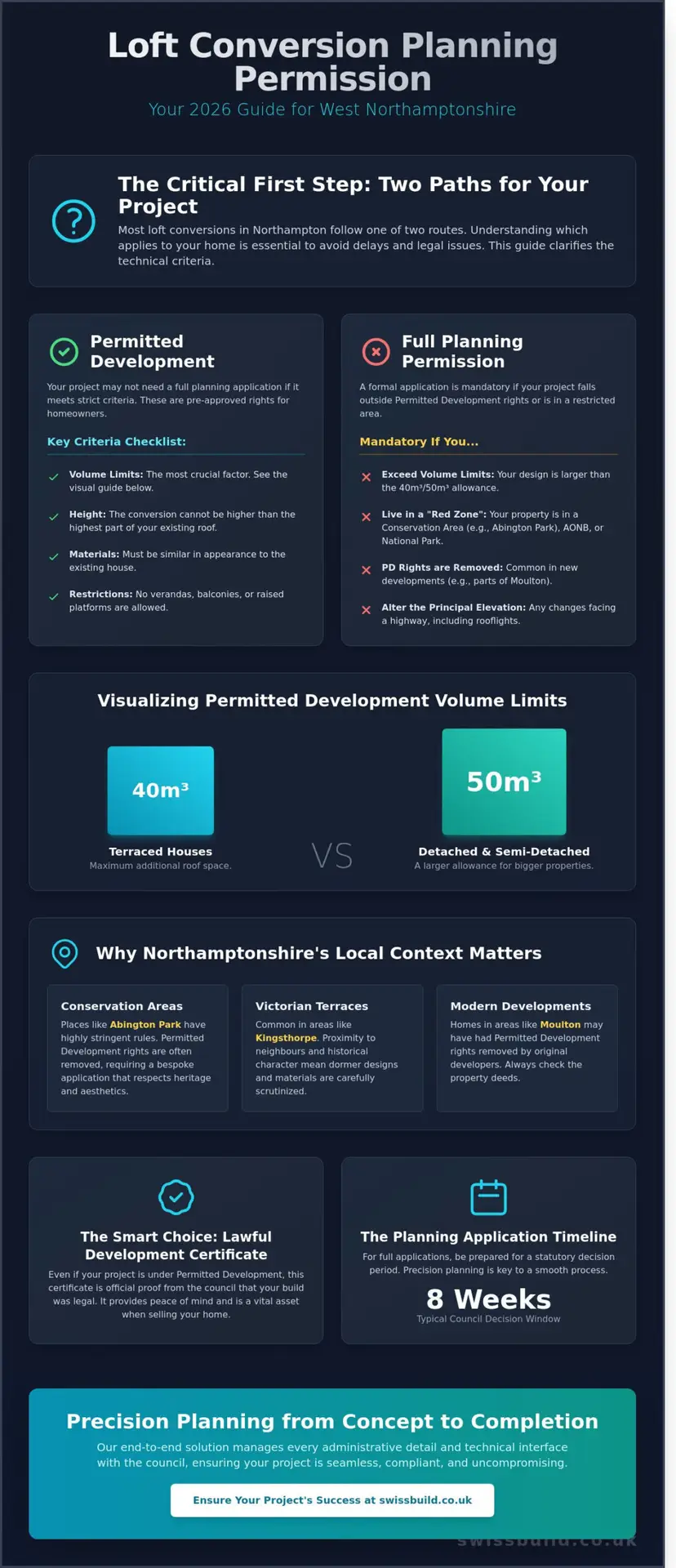
To determine if do you need planning permission for a loft conversion, we must assess the volume of the addition. For terraced houses, the limit is typically 40 cubic metres, while detached and semi-detached homes are allowed up to 50 cubic metres. Any design exceeding these parameters or involving materials that clash with the existing structure will require a full application to the local authority.
Why Local Context Matters for Northamptonshire Homeowners
West Northamptonshire Council serves as the governing body for Moulton, Kingsthorpe, and the surrounding villages. Their specific local plans dictate how modern luxury can coexist with heritage. Permitted Development is a set of pre-approved rights for householders. However, the age and style of your property significantly influence your starting point.
- Victorian Terraces: Properties in Kingsthorpe often feature strict limitations due to their proximity to neighbours and historical character.
- Modern Developments: Homes in Moulton or Collingtree may have had their Permitted Development rights restricted or removed by the original developers.
- Conservation Areas: If your home sits within a protected zone, the rules are significantly more stringent, requiring a bespoke approach to design.
Our team manages the technicalities of these local variations with professional authority. We ensure that every architectural detail aligns with council expectations before a single brick is laid. This proactive strategy reflects our commitment to reliability, transforming a complex regulatory process into a structured, stress-free experience for our clients.
Permitted Development Rights: The Technical Criteria for Your Attic
In many instances, homeowners can bypass the full application process by adhering to Permitted Development (PD) rights. These rights function as a pre-approved set of criteria that allow for specific enlargements without formal consent. However, the margin for error is slim. To determine do you need planning permission for a loft conversion, you must first assess whether your proposal fits within strict volume and height parameters. The primary rule is that the new roof space must not exceed the highest part of the existing roof, ensuring the silhouette of the property remains balanced and respectful of the original design.
The Volume Calculation: 40m³ vs 50m³
The allowance for additional roof space is strictly defined by the type of dwelling you own. Terraced houses are restricted to an additional 40 cubic metres of space. Semi-detached and detached properties are granted a slightly larger allowance of 50 cubic metres. When planning a dormer loft conversion, calculating this volume requires absolute precision. You must measure the external volume of the new structure accurately. It’s vital to remember that any previous roof extensions added to the property since 1948 will eat into this total allowance. Fortunately, standard Velux windows that don’t protrude more than 150mm from the roof plane typically don’t count towards these volume limits.
Aesthetic and Structural Limitations
Maintaining the architectural integrity of Northampton’s residential streets is a core requirement of PD rights. The official government guidance mandates that the materials used in the conversion must be similar in appearance to the existing dwelling. This ensures a seamless transition between the heritage of the original build and the modern addition. Additionally, any dormer extension must be set back at least 20cm from the original eaves, measured along the roof slope, to minimize the visual impact on the streetscape.
Structural elements like balconies, verandas, or raised platforms are strictly prohibited under these rights. Side-facing windows must be fitted with obscure-glazing to protect neighbor privacy and must be non-opening unless the parts that open are more than 1.7 metres above the floor level. If your project deviates from these meticulous standards, the answer to do you need planning permission for a loft conversion becomes a definitive yes. For those seeking an uncompromising finish that respects these complex regulations, our team at Swiss Build can provide a comprehensive feasibility study to ensure your vision aligns perfectly with local requirements.
When Full Planning Permission is Mandatory for Northampton Lofts
Precision in planning is the hallmark of a successful renovation. While many homeowners hope to bypass the local authority, certain conditions make full planning permission an absolute requirement. In Northampton, specific ‘Red Zones’ demand a more rigorous application process. If your property resides within the Abington Park conservation area or the historic pockets of Kingsthorpe Village, standard Permitted Development rules rarely apply. Owners of flats and maisonettes face a similar reality. These property types never possess PD rights, meaning every attic transformation requires a formal application to West Northamptonshire Council.
Beyond location, legal overlays like Article 4 Directions can strip away your rights on specific streets to preserve the town’s aesthetic integrity. These directions are often implemented in areas where the council wishes to protect the visual harmony of a terrace or a specific architectural era. If your home is a Listed Building, the complexity increases significantly. You’ll need both planning permission and Listed Building Consent. This ensures that every bespoke detail, from the timber frame to the lead flashing, aligns with the building’s historical significance and structural heritage.
Conservation Areas and Designated Land
Living in a Northamptonshire conservation area fundamentally changes your design options. The council prioritizes the character and appearance of the neighborhood, which often precludes large, boxy dormers on front-facing elevations. To proceed, you’ll likely need to submit a Heritage Statement. This document provides a meticulous analysis of how your project respects local history. In these restricted zones, low-profile roof-light conversions are frequently the only viable path to approval, as they maintain the original roof slope without disrupting the skyline.
Structural Changes Beyond the Roofline
Any modification that alters the fundamental silhouette of your home triggers a need for full permission. If you plan to raise the ridge line to create more headroom, you’ve moved beyond the scope of Permitted Development. This is a common requirement in Moulton, where older cottages often need structural height adjustments to create a functional living space. Establishing exactly when do you need planning permission for a loft conversion involves a meticulous review of your property’s legal status.
You might notice a neighbor has a large dormer while your own proposal faces hurdles. It’s vital to remember that planning policies evolve. A project approved in 2010 doesn’t set a modern precedent, as current regulations regarding ‘Hip-to-Gable’ extensions on semi-detached homes are far more exacting. Our team ensures your vision is executed with technical mastery, managing these complexities to provide a seamless, turnkey experience.
Navigating the West Northamptonshire Council Application Process
The journey toward a bespoke loft space in Northampton follows a disciplined sequence. It begins with the creation of technical architectural drawings that translate your vision into a structural reality. Once these plans are finalized, they’re submitted to West Northamptonshire Council. You should expect an 8-week statutory timeline for a decision. This period allows planning officers to ensure the design respects the local architectural fabric and complies with all relevant policies.
If you own a semi-detached or terraced property, the Party Wall Act 1996 is a critical factor. You’re legally required to serve notice to your neighbors at least two months before work commences. This ensures that shared boundaries are protected and that the construction process remains transparent and professional. While many homeowners ask, do you need planning permission for a loft conversion if the work stays within Permitted Development, the answer often involves securing formal documentation to prove that very fact.
Applying for a Lawful Development Certificate (LDC)
An LDC represents the gold standard for homeowners working under Permitted Development. It’s a formal document issued by the council that confirms your conversion was legal at the time of construction. This isn’t just a bureaucratic formality; it’s a vital asset. When you eventually sell your home, the buyer’s solicitor will require an LDC to prove the structural changes didn’t breach planning laws. The drawings required for an LDC must be executed with absolute technical precision. Any minor error in measurements or scale can lead to a refusal, which is why Swiss Build manages this submission with meticulous attention to detail.
The Critical Role of Building Control
Planning permission and Building Regulations Northamptonshire serve two distinct purposes. While planning focuses on the external appearance and local impact, Building Control focuses on the internal integrity of the build. Building Control is the body that ensures your loft is physically safe to inhabit. This involves rigorous inspections of fire safety protocols, thermal insulation, and staircase pitch.
Structural calculations are a non-negotiable component of the Swiss Build process. We verify the load-bearing capacity of your existing walls to ensure they can support the new floor and roof structure. This systematic approach guarantees that your new master suite or home office isn’t just aesthetically stunning, but structurally uncompromising.
Ready to begin your transformation with a team that values precision? Contact Swiss Build for a professional consultation regarding your loft conversion today.
Precision Planning: The Swiss Build End-to-End Solution
Determining whether do you need planning permission for a loft conversion is often the most stressful phase of a home renovation. Swiss Build eliminates this uncertainty by managing the entire planning and building control interface on your behalf. We don’t just provide a builder; we provide a dedicated project partner who handles every technicality. Our team has spent 26 years building professional relationships with Northamptonshire planning officers. We understand the specific requirements of West Northamptonshire Council and the nuances of local development plans. This deep-rooted local expertise ensures that your application is handled with a level of precision that minimizes delays.
Our commitment to transparency is reflected in our fixed-price approach. We believe that luxury construction should be predictable. When we provide a quote, it includes all planning-related administrative work, structural calculations, and building control fees. You won’t encounter unexpected costs for the time we spend liaising with authorities. This turnkey service is designed for the discerning homeowner who values their time and demands a seamless experience. We take total accountability for the process, from the first survey to the final sign-off, providing a steady hand to execute your vision without error.
From Concept to Meticulous Execution
We believe a beautiful space is only successful if it’s built to an exacting technical standard. Our architectural team integrates planning constraints directly into the initial bespoke design phase. This proactive method prevents the heartbreak of falling in love with a design that isn’t legally viable. The Swiss Build signature is this marriage of luxury finishes and uncompromising technical integrity. We ensure that every structural element, from steel placement to thermal efficiency, exceeds building regulations while maintaining the aesthetic flow of your home. To see how professional planning fees and administrative management fit into a comprehensive project budget, explore our Loft Conversion Cost Northampton guide.
Your Next Steps in Northampton
Every property in Northamptonshire is unique. Whether you own a Victorian terrace in Kingsthorpe or a detached modern home in Moulton, the answer to do you need planning permission for a loft conversion depends on your specific roofline and local constraints. We invite you to book a comprehensive site survey for a definitive planning assessment. Our local presence in the county allows us to respond quickly and provide the professional authority required for high-end renovations. Let us transform your attic into a precision-engineered living space that adds both value and beauty to your home. Contact Swiss Build for a precision loft consultation to begin your journey with absolute confidence.
Elevating Your Northampton Home with Meticulous Precision
Navigating the nuances of Permitted Development and West Northamptonshire Council regulations requires a disciplined approach to ensure your investment stays protected. While many projects fall under national criteria, specific factors like conservation areas or roof height extensions often necessitate a formal application. Swiss Build brings over 26 years of Northamptonshire construction expertise to every project, ensuring that the question of whether do you need planning permission for a loft conversion is answered with absolute technical certainty.
We provide fixed-price residential construction quotes to eliminate financial ambiguity; we manage every detail from the initial architectural drawings through to the final structural sign-off. This end-to-end solution allows you to focus on the vision of your new space while we handle the rigorous administrative and build requirements. It’s a process defined by transparency and superior craftsmanship. Your journey toward a bespoke, high-end attic transformation deserves the steady hand of an expert artisan who values substance over hype.
Book Your Bespoke Loft Consultation with Swiss Build
Frequently Asked Questions
Is it illegal to convert a loft without planning permission in Northampton?
Converting a loft without the required consent in Northampton isn’t an immediate criminal offence, but it represents a serious breach of planning control. West Northamptonshire Council possesses the authority to issue an enforcement notice requiring you to dismantle the work and return the property to its original state at your own expense. If you fail to comply with such a notice, it becomes a criminal matter that can lead to unlimited fines and a permanent record on the property’s title. Our team prioritises absolute reliability by verifying your project’s status before any construction begins.
How much does planning permission cost for a loft conversion in 2026?
The current statutory fee for a householder planning application in England is £258. While the government reviews these costs periodically, you should budget approximately £300 for the 2026 period to account for potential inflationary adjustments by the Department for Levelling Up, Housing and Communities. This figure only covers the council’s administrative processing. A successful, high-end conversion requires additional investment in meticulous architectural drawings and structural calculations to ensure the submission meets the uncompromising standards required for approval.
Can I build a dormer on the front of my house without permission?
You generally cannot build a front-facing dormer under Permitted Development rights. Any addition that extends beyond the plane of the existing roof slope on the principal elevation, which is usually the side facing the highway, requires a full planning application. These regulations exist to maintain the aesthetic harmony of the streetscape. For clients seeking an aspirational finish, we often recommend bespoke rooflight solutions or carefully navigated planning applications that respect the architectural integrity of the original building.
What is the 4-year rule for loft conversions and does it still apply?
The 4-year rule no longer applies to loft conversions in England following significant legislative changes. Under the Levelling-up and Regeneration Act 2023, which took effect on 25 April 2024, the time limit for local authorities to take enforcement action against unauthorised development was extended to 10 years. This change means West Northamptonshire Council has a decade to challenge any work completed without consent. We eliminate this risk by securing a Lawful Development Certificate, providing you with documented peace of mind that your investment is fully protected.
Do I need planning permission for a Velux window loft conversion?
Most homeowners don’t need planning permission for a loft conversion that only utilises Velux windows, as these typically fall under Permitted Development. To remain compliant, the windows must not protrude more than 150mm beyond the existing roof plane and any side-facing glazing must be obscure-glazed to protect privacy. However, if your home is one of the 21 designated conservation areas in Northampton, these rights are often restricted. We provide a turnkey service that handles these technicalities, ensuring your design is both beautiful and legally sound.
What happens if West Northamptonshire Council refuses my planning application?
If your application is refused, you have the right to lodge an appeal with the Planning Inspectorate within 12 weeks of the decision date. A more efficient route often involves submitting a revised design that directly addresses the specific concerns raised by the planning officer in their report. Our disciplined approach involves engaging in pre-application discussions with council officials to identify potential hurdles early. This professional foresight significantly reduces the likelihood of a refusal and ensures a seamless transition from concept to execution.
How do I know if my Northampton home is in a conservation area?
You can verify your property’s status by consulting the West Northamptonshire Council interactive conservation map, which details areas like St Giles, Derngate, and Dallington. Properties within these zones are often subject to Article 4 Directions that remove standard Permitted Development rights to preserve the area’s heritage. In such cases, even minor external changes require a meticulous planning strategy. We specialise in navigating these complex requirements, delivering a bespoke result that honours the historical character of your neighbourhood.
Does a loft conversion require a Party Wall Agreement?
A loft conversion requires a Party Wall Agreement if the project involves structural work on a shared wall, such as inserting steel support beams or increasing the wall’s height. Under the Party Wall etc. Act 1996, you’re legally obligated to serve a formal notice to your neighbours at least two months before the build commences. This process is a vital component of our systematic management style, ensuring that the structural integrity of both properties is respected and that all legal protections are firmly in place for a smooth construction journey.