
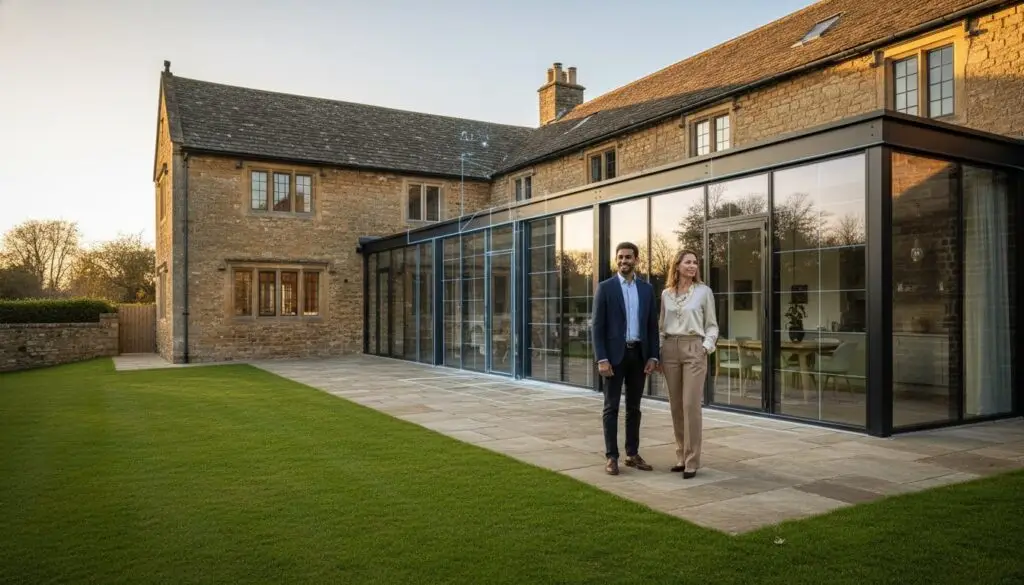
By the time you submit your application in 2026, the cost of securing planning permission for extension northamptonshire will have risen by an estimated 15% compared to 2024 levels. This financial shift, coupled with the diverging policies of West and North Northamptonshire Councils, means that a “wait and see” approach is no longer a viable strategy for the discerning homeowner. It’s a complex landscape where precision is mandatory. You likely recognise that while the vision for your home is clear, the path through local authority regulations feels increasingly opaque and fraught with the risk of enforcement action.
This guide provides the absolute clarity you require to transform your architectural aspirations into a tangible reality. We promise to demystify the complexities of the 2026 planning cycle, offering a precise roadmap that secures approval for your bespoke living space without the typical anxieties of delay. You’ll discover the specific policy shifts in West and North Northants, the updated 2026 fee schedules, and the benefits of a turnkey partnership that manages every meticulous detail with uncompromising standards.
Key Takeaways
- Understand the jurisdictional nuances between West and North Northamptonshire Councils to align your bespoke vision with local aesthetic and community policies.
- Discern the strict criteria for Permitted Development to determine if your luxury home improvements can be realised without the need for a full planning submission.
- Prepare for the 2026 fiscal landscape by mastering the updated fee structures and administrative timelines required for planning permission for extension northamptonshire.
- Explore how a seamless, turnkey methodology reduces planning risk by marrying aspirational design with uncompromising technical discipline.
- Gain a step-by-step roadmap for a successful application, from initial feasibility studies to the creation of meticulous architectural drawings that ensure compliance.
Understanding Planning Permission for Extensions in Northamptonshire
Planning permission serves as a vital mechanism for maintaining the architectural integrity and community balance of our local landscapes. It governs how a project impacts the surrounding environment, ensuring that new developments respect the character of established neighbourhoods. While a conceptual sketch might capture the imagination, it is the rigorous application of the UK town and country planning system that ensures a project becomes a lawful reality. For homeowners, securing planning permission for extension northamptonshire projects is the first step in transforming a conceptual vision into a tangible, permanent asset.
Northamptonshire presents a unique architectural tapestry. The county features a sophisticated mix of historic market towns such as Towcester and Oundle, alongside rapidly expanding urban centres and protected rural villages. This diversity requires a bespoke approach to every application. A glass-fronted contemporary extension that suits a modern plot in Grange Park might face significant scrutiny in a conservation area like Collyweston. Precision in the design phase is not merely about aesthetics; it is about demonstrating a meticulous respect for the local context to satisfy council planners.
The risks of bypassing this formal process are substantial. Local authorities have the power to issue enforcement notices, which can mandate the complete demolition of an unauthorised structure. While some owners hope for retrospective approval, this is a precarious strategy. Statistics suggest that councils are often less lenient with builds that have already been completed without consultation. Securing the correct permissions from the outset provides the peace of mind that your investment is protected and your property’s title remains unencumbered.
West vs. North Northants: Which Authority Governs Your Build?
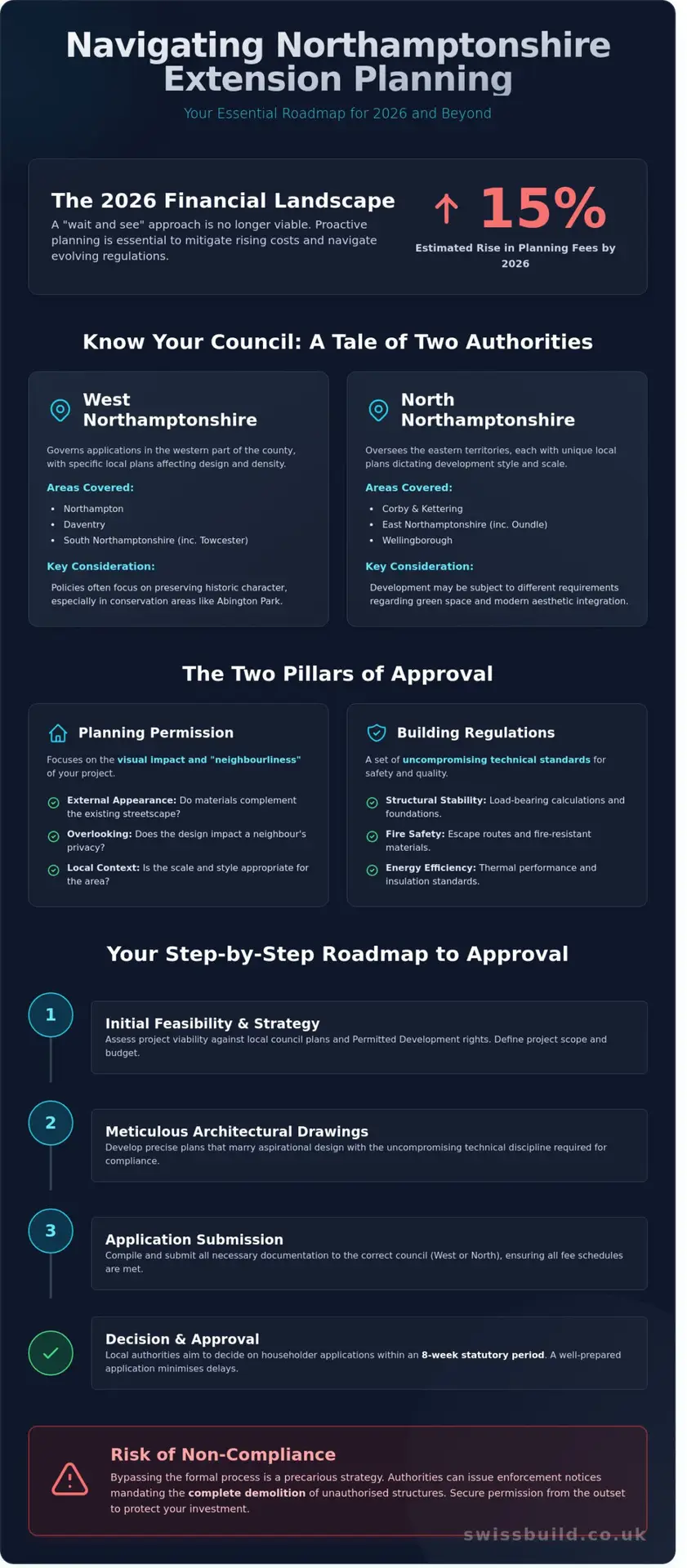
Since the local government reorganisation in April 2021, Northamptonshire is governed by two unitary authorities. West Northamptonshire Council manages applications for Northampton, Daventry, and South Northamptonshire. North Northamptonshire Council oversees Corby, East Northamptonshire, Kettering, and Wellingborough. Each council operates under its own specific Local Plan, which dictates the density and style of residential growth. For instance, policies in the Abington Park area often focus on preserving Victorian character, while developments in Kettering may be subject to different green-space requirements. Identifying your specific council based on your postcode is the first step in our disciplined planning process.
Planning Permission vs. Building Regulations
It is essential to distinguish between planning permission and building regulations, as they serve two distinct purposes. Planning is concerned with the external appearance and the “neighbourliness” of the build. It asks whether the extension overlooks a neighbour’s garden or if the materials complement the existing streetscape. Building regulations are an uncompromising set of technical standards focused on the invisible quality of the build. These include:
- Structural stability and load-bearing calculations
- Fire safety measures and escape routes
- Thermal performance and energy efficiency levels
- Drainage and ventilation systems
Most high-end extensions require both approvals. Even if a project falls under Permitted Development, it must still meet the stringent criteria of building control. Local authorities aim to decide on householder planning applications within an 8-week statutory period, though complex bespoke designs may require additional consultation. Securing planning permission for extension northamptonshire requires a deep understanding of these local nuances to ensure a seamless transition from design to execution.
Permitted Development: When You Can Build Without Planning
Permitted Development (PD) rights function as a national grant of planning permission, allowing you to enhance your property without the traditional, often lengthy, application process. For many homeowners seeking UK permitted development rights for extensions, these rules provide a clear, albeit rigid, framework. To qualify, your project must adhere to exacting standards. Single storey rear extensions cannot exceed four metres in height; if the structure sits within two metres of a boundary, the eaves height is restricted to three metres. Materials must also match the existing dwelling to maintain architectural cohesion. These rules offer a streamlined path, yet they require a meticulous approach to design to ensure every millimetre complies with the General Permitted Development Order.
Securing planning permission for extension northamptonshire isn’t always a requirement, but the peace of mind offered by a Lawful Development Certificate (LDC) is invaluable. While not legally mandatory, an LDC provides formal proof that your build was legal at the point of construction. This document is essential when you eventually decide to sell your property. It acts as a shield against future legal queries, confirming your home’s evolution was handled with absolute discipline. Without it, you may face delays or be forced to apply for retrospective consent during a sensitive property transaction.
The “Larger Home Extension” Scheme
The 2013 amendments introduced a more generous allowance for those needing extra space. Under the Prior Approval regime, owners of detached homes can extend up to eight metres to the rear, while semi detached properties are limited to six metres. This isn’t a total bypass of authority. You must notify West Northamptonshire Council before a single brick is laid. The council then triggers a 21 day consultation period with your immediate neighbours. If an objection is raised, the council will assess the impact on local amenity. It’s a delicate balance that requires professional project management to navigate successfully.
Article 4 Directions in Northamptonshire
Local authorities use Article 4 Directions to withdraw PD rights in specific areas to protect the character of the neighbourhood. In Northampton, this is particularly common in Victorian terraces across Abington and Kingsley, or within the 40 plus designated conservation areas. In these zones, even minor changes like replacing a window or adding a small porch might require full planning consent. You can verify your property’s status via the West Northamptonshire Council planning portal. Precision at this stage prevents costly enforcement action later. Always check these local rules before assuming your PD rights remain intact, as the council has the power to restrict them without individual notice.
- Rear Extensions: Maximum 4m depth for detached houses under standard PD.
- Side Extensions: Must be single storey and not exceed half the width of the original house.
- Height Restrictions: Maximum height of 4m for a single storey extension; 3m at the eaves if close to a boundary.
- Conservation Areas: PD rights are frequently removed or restricted to preserve local heritage.
The 2026 Planning Landscape: Fees, Timelines, and Constraints
Securing a successful outcome for your property requires a disciplined understanding of the current regulatory environment. On 1 April 2026, planning fees across West and North Northamptonshire councils underwent a scheduled 10% increase to address the growing demand for local authority resources. For homeowners seeking planning permission for extension northamptonshire, the standard householder application fee now stands at £322. This financial commitment is a small fraction of the overall investment, yet it serves as the gateway to your project’s legal viability.
Timelines for “householder” applications in Northamptonshire currently average ten to twelve weeks from the point of validation. While statutory targets aim for eight weeks, the administrative climate in 2026 remains stretched; approximately 68% of applications in the region now face minor delays due to staffing constraints. We manage this by ensuring every document is meticulously prepared before submission, which eliminates the common “request for further information” cycle that stalls so many builds. Precision at the outset is the only way to guarantee a seamless transition from paper to ground-breaking.
Larger residential projects must also account for the Community Infrastructure Levy (CIL). If your extension adds more than 100 square metres of internal floor space, you may be liable for this charge. In high-demand zones within the county, CIL rates can reach £150 per square metre. However, self-build exemptions often apply to residential extensions if the property remains your primary residence for three years post-completion. Our role is to navigate these technicalities with professional authority, ensuring you don’t pay more than is legally required.
Restrictive covenants represent a private layer of constraint often found in Northamptonshire property deeds. These are legal promises that stay with the land, regardless of council approval. In established areas like Collingtree or White Hills, roughly 22% of properties contain historic clauses that forbid external changes without the consent of the original estate developer. Ignoring these can lead to an injunction even after your extension is built. We treat the deed search as a priority, providing the peace of mind that your vision is protected from future legal challenges.
Calculating Your 2026 Application Costs
Budgeting for your extension requires looking beyond the £322 council fee. Prior Approval notifications for larger single-storey extensions cost £120 but require technical precision to avoid rejection. Hidden costs often include bat surveys, which average £550 in rural Northamptonshire, and tree reports for projects near protected oaks. Investing in bespoke, high-fidelity architectural plans early prevents the £2,500 redesign fees that occur when poorly conceived ideas clash with local planning policy. To build a complete financial picture before committing to a full application, reviewing a detailed breakdown of house extension cost Northampton figures for 2026 will help you plan with absolute confidence.
Conservation Areas and Listed Buildings
Northamptonshire is home to over 150 conservation areas where the standard Permitted Development rights are often restricted or removed entirely. If your home is in a village like Blisworth or Badby, the council will mandate “matching materials” to preserve the streetscape. This usually means sourcing authentic Northamptonshire ironstone or specific reclaimed brickwork. Listed Building Consent adds a further six to eight weeks of scrutiny, focusing on the preservation of the building’s historic fabric through uncompromising craftsmanship.
The Step-by-Step Process to Securing Planning Approval
Securing planning permission for extension northamptonshire demands more than aesthetic vision; it requires a rigorous, technical strategy. At Swiss Build Ltd, we treat the feasibility study as the foundation of your project’s success. We identify hidden constraints like Northamptonshire limestone heritage requirements or specific biodiversity net gain targets that, as of 2026, now impact even smaller residential builds. Our team identifies these variables early to ensure the design remains both aspirational and achievable.
The pre-application stage remains a vital tool for risk mitigation. For a standard fee of £240, West Northamptonshire Council provides a written response that highlights potential hurdles before they become costly errors. This proactive step typically shortens the final approval window by 14 days because the assigned officer is already familiar with the project’s intent. It’s a small investment that provides 100% clarity before you commit to full technical drawings.
Once we submit the formal application, the 8-week statutory clock begins. During this period, our project managers maintain a transparent dialogue with the planning officer. This ensures any minor queries regarding materials or scale are resolved instantly. After receiving your approval letter, we manage the discharge of conditions. This involves submitting specific material samples, such as bespoke slate or heritage brickwork, to ensure the final build meets the exact standards of the original permission.
Preparing a Meticulous Application
Precision is the hallmark of a successful submission. We provide a comprehensive pack including 1:1250 scale location plans and 1:500 block plans that detail every boundary. For projects in sensitive areas like the Derngate Conservation Area, we draft a bespoke Design and Access Statement. This document justifies the architectural choices and demonstrates how the extension respects the 45-degree rule. This technical standard ensures your planning permission for extension northamptonshire isn’t compromised by blocking a neighbour’s natural light, a factor that accounts for 18% of local planning disputes.
To further enhance the clarity of a proposal, digital visualization has become an invaluable tool. While professional drawings are the standard, you can explore software like 3D Cityplanner to see the level of detail modern planning can achieve. These tools help stakeholders understand the visual impact and compliance of a project long before breaking ground.
The Decision Process and Appeals
Understanding who decides your application is crucial for peace of mind. In Northamptonshire, 92% of householder applications are decided under delegated powers. This means a senior planning officer makes the final call without a public committee meeting. If a project is particularly complex or faces significant local objection, it may be referred to the Planning Committee. Should a refusal occur, it’s rarely the end of the journey. You have a 12-week window to lodge an appeal with the Planning Inspectorate. However, we often find that submitting an amended scheme is a more efficient route to breaking ground. Our disciplined approach to design usually avoids these delays, ensuring a seamless transition from paper to precision construction.
The Swiss Build Approach: Precision Planning and Execution
Since 1998, Swiss Build has managed the complexities of the local landscape with a focus on architectural integrity. With 26 years of heritage, we understand how to secure planning permission for extension northamptonshire projects without the typical delays that plague less experienced firms. Our method is rooted in discipline. We don’t just build; we orchestrate every detail from the first sketch to the final brick. This longevity provides us with an intimate knowledge of West Northamptonshire Council’s specific requirements, ensuring your vision aligns with local policy from day one.
We operate on a turnkey philosophy. By unifying design and construction under a single point of accountability, we eliminate the risks that often derail high-end renovations. Traditional routes often lead to friction between architects and builders, which frequently results in 15% to 20% budget overruns or planning failures. Our integrated model ensures that the technical feasibility of a design is verified before it reaches a planning officer’s desk. This systematic management offers you peace of mind through a fixed-price contract, protecting your capital from the volatility of material costs and labour fluctuations. Understanding the full scope of house extension cost Northampton projections for 2026 is an essential part of this financial discipline, ensuring your budget is anchored to current market realities from the outset.
Our portfolio reflects this commitment to excellence through tangible results. In 2022, we completed a complex rear extension in Abington that required sensitive integration with a Victorian terrace. By meticulously matching the original 19th-century brickwork and lime mortar, we secured approval in just eight weeks. Similarly, a 2023 project in Wootton involved a substantial 65-square-metre double-storey addition. Despite strict local constraints regarding overlooking and natural light, our precision-led approach meant the project passed every building control inspection without a single remedial action required.
Bespoke Design Meets Regulatory Mastery
We believe an extension should look like it has always been there. Our design team focuses on architectural continuity, ensuring new structures complement the existing heritage of your home. This attention to detail isn’t just aesthetic; it’s a strategic choice to satisfy the most rigorous planning officers. You can explore our Home Extensions Northampton services to see how we balance luxury with technical compliance. We prioritise materials that age gracefully, matching stone and timber to the local Northamptonshire vernacular.
From Concept to Completion
The journey from a conceptual vision to a finished living space requires absolute precision. We remove the burden from the homeowner by managing every building control milestone and site inspection. Our team maintains a steady, methodical pace, ensuring that the invisible quality of the build matches the visible luxury of the finish. This is why we maintain a high success rate when we handle planning permission for extension northamptonshire applications from the initial design phase. If you’re ready to start your journey, Enquire about your Northamptonshire extension today to discuss your requirements with our expert team.
Transforming Your Vision into a Northamptonshire Landmark
Navigating the complexities of planning permission for extension northamptonshire requires more than just a conceptual design; it demands technical mastery and an intimate understanding of the 2026 regulatory framework. Whether you’re leveraging permitted development rights or submitting a full application to meet the 8-week statutory decision target, the finer details define the ultimate outcome. Swiss Build brings over 26 years of construction expertise to every project, ensuring your architectural ambitions are met with rigorous discipline and uncompromising quality. We provide a fixed-price residential construction guarantee to eliminate financial ambiguity, alongside comprehensive project management that spans from the initial planning stages to the final handover. Every brick is laid with the same meticulous care we apply to our systematic management processes. You don’t have to navigate the intricacies of local constraints alone when a partner with a proven heritage of excellence is ready to lead the way. Your home deserves a legacy of precision and a seamless transition from blueprint to reality.
Start your precision-engineered extension journey with Swiss Build
Your journey toward a bespoke, masterfully crafted home begins with a single, decisive step toward excellence.
Frequently Asked Questions
Do I need planning permission for a small kitchen extension in Northampton?
You won’t typically need planning permission for a small kitchen extension Northampton project if it adheres to Permitted Development rights. For a standard semi-detached home in Northampton, you can extend up to 3 metres from the original rear wall. Detached properties allow for 4 metres. If your home is situated within one of the 40 conservation areas in West Northamptonshire, these rights are often restricted. We recommend a Certificate of Lawfulness for total peace of mind.
How much does planning permission cost in Northamptonshire in 2026?
A standard householder planning application in Northamptonshire is expected to cost £258 in 2026. This fee is paid directly to the local authority for processing your submission. Beyond this, you should budget between £3,000 and £7,500 for a bespoke architectural package. Our end-to-end solution includes these meticulous drawings and structural calculations, ensuring your vision is translated into a technically perfect reality without unforeseen financial surprises.
How long does it take to get planning approval for a house extension?
West Northamptonshire Council aims to deliver a decision within 8 weeks for standard residential extensions. This statutory timeframe includes a 21-day public consultation period where neighbours can comment on your proposal. For complex bespoke designs or larger builds, the process can extend to 13 weeks. We recommend allowing a 12-week window in your project timeline to account for any necessary revisions or technical clarifications required by the planning officer.
Can I build a two-storey extension under Permitted Development?
You can build a two-storey extension under Permitted Development provided it’s at the rear of your property and doesn’t exceed 3 metres in depth. The structure must be at least 7 metres from the rear boundary to comply. Obtaining planning permission for extension northamptonshire is still required if you intend to build on the side of the house. Every detail, from roof pitch to window placement, must match the existing architectural integrity.
What is the “Prior Approval” process for larger extensions?
The Prior Approval process is a streamlined notification for single-storey rear extensions between 3 and 6 metres for semi-detached houses. For detached properties, this limit increases to 8 metres. You must submit a formal notification to the council, who then consult your immediate neighbours for 21 days. If no objections are raised, you receive a permitted development confirmation. It’s a systematic approach that balances speed with regulatory discipline.
Will I need planning permission for a garden room in my Northamptonshire home?
Most garden rooms don’t require planning permission as they fall under Class E outbuildings. To qualify, the structure must be single-storey with a maximum eaves height of 2.5 metres and shouldn’t take up more than 50% of your garden space. If you plan to use the room as a primary bedroom or a self-contained annex, you’ll need to submit a full application. This ensures compliance with local residential standards and building regulations.
What happens if I build an extension without planning permission?
Building without consent risks an enforcement notice from West Northamptonshire Council, which can mandate the total demolition of the structure. It’s a costly error that also makes selling your property nearly impossible, as buyers’ solicitors require proof of legality. You can apply for retrospective permission, but there’s no guarantee of approval. We manage every technical detail from the start to ensure your project remains beyond reproach and fully compliant.
Do I need a bat survey for my extension in Northamptonshire?
You’ll need a bat survey if your project involves roof work or is located near the 160 hectares of woodland in the Nene Valley. Since all 17 species of UK bats are legally protected, the council requires a Preliminary Ecological Appraisal before granting planning permission for extension northamptonshire. If evidence of roosting is found, we integrate specific mitigation strategies into the build. This ensures your project proceeds with absolute legal and environmental certainty.