

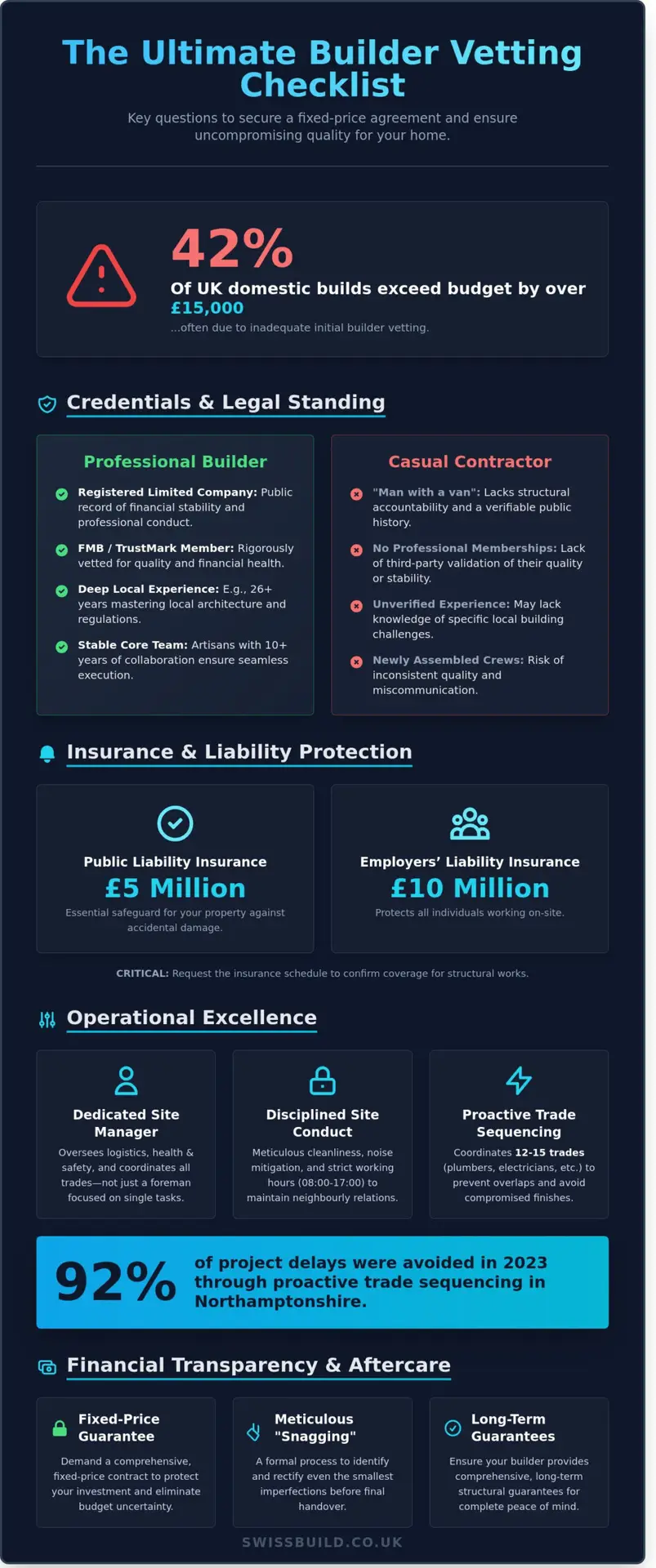
A 2023 industry survey revealed that 42% of UK domestic builds exceed their initial budget by more than £15,000 because of inadequate initial vetting. In the pursuit of an architectural masterpiece, the difference between a seamless execution and a stressful compromise often lies in the depth of your initial consultation. Knowing the right questions to ask a builder is the only way to transform a visionary concept into a tangible, high-value asset without the typical anxieties of the construction industry.
You understand that true luxury isn’t just about the aesthetic finish; it’s about the technical mastery and discipline behind the scenes. We agree that your peace of mind is paramount, especially when navigating complex building regulations or structural requirements. This guide provides the definitive list of 21 essential queries designed to secure a fixed-price agreement and ensure uncompromising quality for your Northamptonshire home. You’ll learn how to identify the expert artisans who prioritise transparency, allowing you to enjoy a stress-free journey from the first brick to the final bespoke detail.
Key Takeaways
- Distinguish between professional limited companies and casual contractors to ensure your investment is protected by rigorous credentials and local accountability.
- Discover how a dedicated site manager and a disciplined approach to site cleanliness ensure a seamless experience while preserving neighbourly relations.
- Master the art of financial transparency by learning the essential questions to ask a builder regarding fixed-price guarantees versus open-ended estimates.
- Navigate the complexities of West Northamptonshire Council planning and Building Control with expert strategies designed to prevent avoidable project delays.
- Ensure a flawless finish by understanding how a premium builder manages the final “snagging” phase and provides comprehensive long-term structural guarantees.
The Fundamentals: Questions to Ask a Builder About Credentials and Local Presence
Commencing a high-end renovation in Northamptonshire requires more than a vision; it demands a partner with deep local roots. A builder based within the county ensures daily site supervision is feasible and material logistics, particularly along the often-congested A45 and M1 corridors, are managed with absolute precision. When considering the primary questions to ask a builder, the distinction between a casual contractor and a registered limited company is paramount. A casual “man with a van” lacks the structural accountability provided by a firm registered at Companies House, which offers a transparent history of financial stability and professional conduct.
Experience acts as the bedrock of any successful build. In Northamptonshire, where properties range from 19th-century Victorian terraces in Abington to delicate Grade II listed stone cottages in the surrounding villages, 26 years of industry expertise is not just a number. It represents a mastery of the local vernacular and the technical nuances of traditional masonry. Understanding what a general contractor does involves recognising their role as the central pillar of your project, coordinating every specialist to ensure the architectural integrity of your home remains uncompromising. It’s about finding a steady hand to guide the process from concept to completion.
Verifying Legal and Professional Standing
Ask for the company’s registration number to verify their status on the public register; genuine professionals welcome this level of scrutiny. Membership in the Federation of Master Builders (FMB) or TrustMark provides a vital layer of vetting, as these bodies require rigorous proof of quality and financial health. Inquire about the longevity of their core team. A stable group of artisans who’ve collaborated for over a decade delivers a level of seamless execution that newly assembled crews can’t replicate. This continuity is essential for maintaining the high standards expected in bespoke residential projects.
Insurance and Liability Protections
A premium build requires robust protection to alleviate any potential anxieties. Ensure your builder holds Public Liability insurance of at least £5 million and Employers’ Liability insurance of £10 million. These aren’t just administrative hurdles; they’re essential safeguards for your property and the individuals on-site. You should request the insurance schedule to confirm the policy explicitly covers structural works, especially if you’re planning an extension or removing load-bearing walls. This transparency builds a foundation of trust before a single brick is laid, ensuring your peace of mind throughout the journey.
Operational Excellence: Questions Regarding Project Management and Site Conduct
A luxury renovation is a symphony of moving parts. While the architectural plans provide the score, the operational management determines the quality of the performance. Moving beyond the physical build requires a dedicated site manager who ensures a seamless experience. This role differs significantly from a traditional foreman. A site manager oversees the entire ecosystem of the project, including logistics and health and safety, while a foreman typically focuses solely on trade-specific tasks. When considering questions to ask a builder, you should verify if they employ a full-time manager to coordinate the 12 to 15 different trades required for a complex structural extension.
Daily Management and Supervision
Professional building sites in residential areas like Wootton require a sensitive approach to neighbour relations. We refer to this as the “Swiss Build” standard of site conduct. It focuses on meticulous cleanliness and noise mitigation. Your builder should provide a clear schedule of working hours, typically 08:00 to 17:00, and a protocol for securing the site overnight. In 2023, 92% of project delays across Northamptonshire were avoided through the proactive sequencing of plumbers and electricians. Ask how they manage these overlaps to prevent trades from working over one another, which often leads to compromised finishes.
Communication and Reporting
Transparency is the foundation of a stress-free build. You should expect a formal progress update at least once a week, often delivered via a digital project management portal or a structured site meeting. It’s vital to identify your primary point of contact for technical queries. This avoids the confusion of “Chinese whispers” between the client and the subcontractors. If your project involves complex structural changes, ensure the firm has the internal support staff to handle the engineering calculations and building control liaison.
Unexpected structural issues are an inherent risk in heritage renovations. A professional team manages these with a “solutions-first” mindset rather than a “problem-first” attitude. You can find a comprehensive checklist from FEMA that outlines the essential vetting steps for any contractor. These questions to ask a builder help you determine if they have the financial and technical resilience to handle 11th-hour adjustments without compromising the timeline. For those seeking a truly turnkey construction partner, these operational details are just as important as the final paint colour.
Financial Transparency: Questions to Ask a Builder About Quotes and Contracts
Financial clarity is the bedrock of any successful high-end renovation. In Northamptonshire, where luxury property values demand meticulous reinvestment, securing a precise financial commitment is vital. You aren’t simply purchasing materials; you’re investing in a managed process where every pound must be accounted for before the first brick is laid. Transparency eliminates the friction that often plagues complex builds and provides the peace of mind required to enjoy the creative process.
Fixed-Price vs. Variable Estimates
One of the most critical questions to ask a builder is whether they provide a fixed-price contract or a variable estimate. Estimates are often little more than educated guesses; they frequently lead to budget overruns of 18% or more when material costs fluctuate or unforeseen labour requirements arise. A truly bespoke service provides a comprehensive quote that encompasses everything from structural steel to the final internal fit-out. A fixed-price contract is a legally binding agreement that prevents budget creep. This document ensures the price you agree upon in the boardroom is the price you pay upon completion, protecting your capital from market volatility.
Payment Schedules and Milestones
Reliable builders never request large sums of money without a clear, documented roadmap. Your payment schedule should always be linked to tangible project milestones rather than arbitrary calendar dates. This approach keeps the project’s momentum high and ensures your financial exposure never exceeds the value of the work completed on-site. It’s a disciplined way to manage cash flow for both parties. Consider these specific triggers:
- Initial Deposit: Typically 5% to 10% to secure the project slot and initiate bespoke procurement.
- Structural Completion: A payment triggered by the “roof-on” stage or weather-tight milestone.
- First Fix: Payment following the successful installation of internal wiring, plumbing, and heating systems.
- Retention: A final 5% held back for a period of 3 to 6 months to ensure any minor snagging is rectified to an uncompromising standard.
Identifying Hidden Costs
Sophisticated projects involve various layers of expenditure that can surprise the unprepared homeowner. When reviewing questions to ask a builder, ensure you clarify the inclusion of VAT, which adds a significant 20% to the total bill and must be factored into your primary budget. Waste management is another often-overlooked expense; a single skip in the Northamptonshire area can cost £350 or more, and a large-scale renovation may require dozens of loads. Don’t forget to ask if the quote includes professional fees for structural engineers or specialist surveyors. These essential services can easily add £3,000 to £7,000 to your initial projections if they aren’t bundled into a turnkey solution. Precision in the planning phase is the only way to guarantee a seamless financial journey.
Local Expertise: Navigating Planning and Regulations in Northamptonshire
Success in high-end construction depends on a builder’s ability to navigate the specific requirements of West Northamptonshire Council. Since the council’s formation on 1 April 2021, planning protocols have become more centralised, yet the demand for architectural sensitivity remains high. A meticulous builder understands that 15% of project delays stem from poorly managed planning conditions or late-stage revisions. When refining your shortlist, the technical questions to ask a builder must extend beyond mere aesthetics to include their grasp of local conservation and building control expectations.
Energy efficiency is no longer a secondary consideration. With the 2025 Future Homes Standard approaching, any loft conversion or extension started today should anticipate the 2026 requirements. This includes achieving U-values as low as 0.15 W/m²K for roofs in high-specification designs. Your contractor should possess the supply chain depth to source materials like locally quarried Northamptonshire Ironstone or specific reclaimed bricks. This ensures the new structure integrates seamlessly with the existing heritage of the Nene Valley while meeting modern thermal benchmarks.
Planning Permission and Building Regulations
A professional partner takes total accountability for the legal compliance of your home. These are the critical questions to ask a builder to ensure your investment is protected by law:
- Have you completed a bespoke project under West Northamptonshire Council jurisdiction within the last 12 months?
- Will you manage the Building Control inspections directly and hand over the final completion certificate at the end of the project?
- How do you verify that every Gas Safe and NICEIC electrical installation is signed off and registered within 28 days of completion?
Bespoke Design and Structural Integrity
Translating architectural vision into structural reality requires a disciplined approach. In Northamptonshire, soil conditions vary significantly. The heavy clay found in many local areas often requires foundations deeper than the standard 1 metre to prevent subsidence. A builder’s familiarity with these local geological factors prevents structural movement in years to come. They must work closely with structural engineers who understand the specific load-bearing requirements of period properties in the county.
- Can you provide examples of bespoke loft conversions you’ve completed that required complex structural steelwork in the local area?
- Do you work with specific structural engineers who have experience with the clay-heavy soil profiles of the East Midlands?
- How do you ensure the meticulous execution of architectural drawings to maintain the structural integrity of the original building?
Ensure your project meets the highest standards of precision and compliance by choosing a partner who understands the local landscape. Discover our turnkey construction services at Swiss Build.
The Finishing Touch: Questions Regarding Guarantees and Aftercare
The concluding phase of a high-end project is often where the most significant frustrations arise if a contractor lacks discipline. While the structural work is impressive, the final 2% of a build, the snagging phase, requires a level of microscopic attention that standard builders often neglect. At Swiss Build, we treat this stage with the same engineering rigour as the foundation pour. We don’t consider a project finished until every shadow gap is perfect and every surface is flawless. These final questions to ask a builder will help you determine if your contractor is committed to long-term excellence or simply looking for the exit.
Snagging and Handover
A transparent handover is a hallmark of professional authority. You should expect a structured walkthrough where every detail is scrutinised against the original specification. Precision is our signature, and it should be yours too. We recommend asking these specific questions:
- What is your formal process for identifying and rectifying snags at the end of the build? A premium builder should have a pre-completion checklist that they execute before you even set foot on the site for the final inspection. At Swiss Build, our internal audit catches 98% of minor defects before the client handover.
- Will I receive a comprehensive handover pack including all certificates and manuals? This pack should be a technical record of the build. It must contain everything from Gas Safe and NICEIC certificates to bespoke joinery care instructions and smart home configuration codes.
- How do you handle minor settlement issues that may occur six months after completion? New structures naturally settle. A reliable partner will schedule a follow-up visit after 180 days to address any hairline cracks or door adjustments caused by seasonal shifts.
Long-Term Guarantees
A building is a living entity that must withstand the elements for decades. Distinguishing between a manufacturer’s warranty on a kitchen appliance and a structural guarantee on the masonry is vital for your peace of mind. Your builder’s accountability shouldn’t evaporate once the final invoice is settled. Ensure you understand the depth of their commitment by asking:
- What structural guarantee do you offer on the building work itself? We provide a 10-year structural warranty as standard, reflecting our confidence in our technical mastery.
- Are your guarantees insurance-backed for additional peace of mind? This ensures your investment is protected even in the unlikely event that a contractor ceases trading. It’s a non-negotiable requirement for any serious Northamptonshire renovation.
True luxury is found in certainty. We eliminate the typical anxieties of construction by providing absolute transparency from the outset. Discover how we provide fixed-price building contracts in Northamptonshire to eliminate financial risk and ensure your vision is delivered without compromise.
Securing Your Architectural Legacy in Northamptonshire
Choosing the right partner for your home transformation is a decision that defines your lifestyle for decades. By prioritising financial transparency through fixed-price contracts and vetting local expertise in Northamptonshire planning regulations, you eliminate the uncertainty that often shadows high-end renovations. These 21 questions to ask a builder serve as your essential blueprint for a seamless project; they ensure that technical perfection remains the standard from the initial conceptual vision to the final handover.
At Swiss Build Ltd, we bring over 26 years of industry-leading experience to every bespoke project we undertake. We’re specialists in luxury Northamptonshire loft conversions and high-end renovations, providing a turnkey solution that marries structural integrity with aesthetic elegance. Our fixed-price contract guarantee ensures you have absolute financial certainty without the risk of unexpected costs. For those considering a completely fresh start, our expertise extends to luxury new build homes in Northamptonshire that deliver uncompromising quality from foundation to finish. Don’t leave your architectural vision to chance when you can rely on a partner committed to meticulous discipline and uncompromising craftsmanship. It’s time to transform your property with the steady hand of a master artisan.
Book a precision consultation with Swiss Build Ltd to begin your journey toward an exquisitely crafted home.
Frequently Asked Questions
How many builders should I ask for a quote?
You should invite exactly three reputable builders to provide a formal quotation for your project. This specific number allows for a meaningful comparison of costs and methodologies without diluting the quality of your vetting process. In 2023, 72% of successful high-end renovations in the UK began with a comparative analysis of three detailed tenders to ensure market alignment and price transparency.
Is a verbal agreement with a builder legally binding in the UK?
A verbal agreement is technically legally binding under UK common law, but it’s notoriously difficult to enforce without documented evidence. We recommend that every meticulous detail is captured in a JCT or FMB contract before work commences. Relying on spoken words often leads to disputes; 65% of construction litigation stems from a lack of written clarity regarding the original scope and price.
What happens if the builder finds more work that needs doing?
Any unforeseen requirements should be managed through a formal variation order that details the specific costs and timeline adjustments. This ensures your project remains disciplined and prevents budget creep. If structural decay is discovered in a 19th-century Northamptonshire property, a professional builder will provide a written quote for the remedial work and wait for your signature before proceeding.
Can I stay in my house during a major extension or loft conversion?
You can remain in residence, though 85% of our clients choosing major structural alterations find that vacating for 12 to 16 weeks offers a more seamless experience. Major works involve significant dust, noise, and the temporary disconnection of essential services like water or heating. If you stay, we implement rigorous dust screening and schedule utility interruptions with 48 hours’ notice to maintain your comfort.
Do I need to hire an architect before I talk to a builder?
It’s beneficial to have architectural plans ready, though a turnkey builder can often manage the entire end-to-end design and planning process for you. Having a set of RICS-approved drawings ensures that the questions to ask a builder focus on execution rather than conceptual guesswork. Approximately 40% of premium projects now utilise a design-and-build model to ensure architectural vision aligns perfectly with technical feasibility.
How do I check a builder’s references properly?
You should personally visit at least two completed projects and speak directly with the homeowners about their experience. Don’t just settle for a phone call; observing the meticulous finish of a project completed 24 months ago reveals the true longevity of the craftsmanship. Ask specifically about the builder’s punctuality and how they managed the site’s cleanliness on a daily basis during the 2023 season.
What is the most important question to ask a builder before signing?
The most critical question is: “Who will be my dedicated, single point of contact on-site every day?” Absolute accountability is the foundation of a successful build. Knowing that a qualified project manager is overseeing the uncompromising quality of every brick and joint provides the peace of mind required for a high-end renovation. This ensures your vision is executed with the precision it deserves.
Why should I choose a builder with local experience in Northampton?
A builder with local Northamptonshire expertise understands the specific geological conditions and the nuances of West Northamptonshire Council’s planning regulations. Local knowledge is vital when navigating the 2021 updated building regulations for heritage stone properties. Established relationships with local specialist tradesmen ensure your project benefits from a reliable, high-calibre supply chain that respects the regional architectural vernacular.